
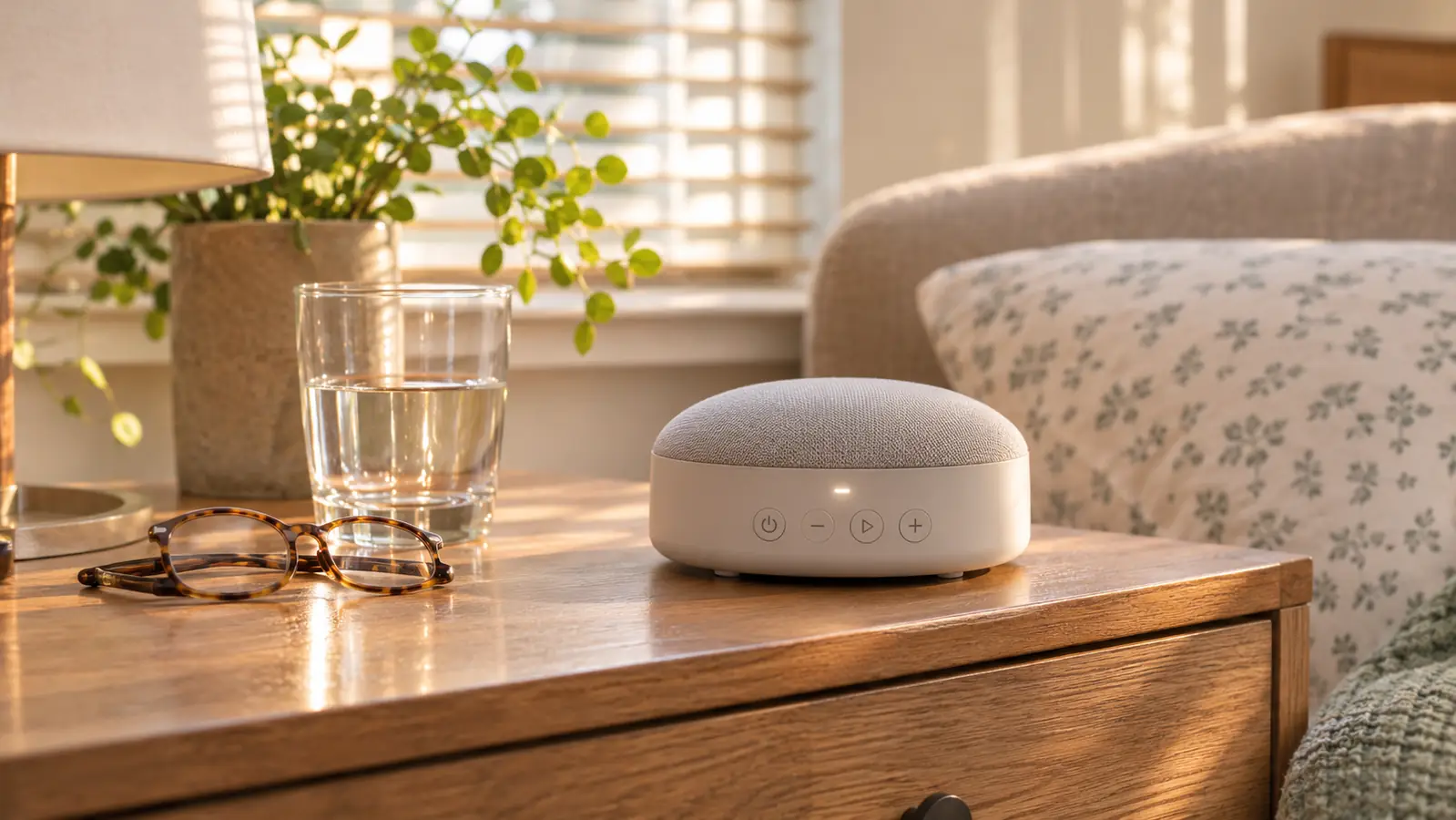
Three weeks after the Magicteam sound machine landed on our bedroom dresser, my husband Dale asked me to turn it down. Not off. Down. I want to start there, because most of what gets written about this little box begins with five stars and the phrase life changing, and that has not been my experience of living with it for nine months. My experience has been quieter and more specific than that, and specific is more useful to you if you are standing in your own bedroom wondering whether a three-inch box can cover the sound of a furnace.
Here is what the Magicteam actually is. A small plastic box, about three inches across and a hair under six ounces, that makes noise and has to be plugged in to do it. Twenty non looping sounds, thirty-two volume steps, a sleep timer and a memory function. That is the whole product. Nothing about it talks to your phone. You press it, it makes rain, you go to sleep. I bought it myself in the first week of February with my own money as part of setting up a quiet room in our house, and it has been on the dresser every night since.
The Quick Verdict
It does one job for nine months without complaint. The sounds are uneven and the cord is the catch nobody photographs, but it replaced the box fan we ran for years and I would buy it again.
Amazon Check Today's Price →The Box That Finally Beat Our Basement Furnace
Twenty sounds, thirty-two volume steps, and a memory that holds your setting so you are not fiddling with it at ten thirty at night. This is the one on our dresser.
Amazon Check Today's Price on Amazon →How I've Used It, and Where It Actually Sits
I am fifty-eight, retired from thirty-one years as a school librarian, and I live in a 1950s brick ranch outside Rockford, Illinois, with Dale, who is sixty-one and a retired machinist. We are not gadget people. Before February the most advanced thing in our bedroom was a clock radio that Dale insists on keeping despite the fact that neither of us has ever set the alarm on it.
The sound machine does not live in my quiet room, which surprises people when I tell them. The quiet room is the smallest bedroom, and it is for reading and stretching and sitting still in the morning. It stays silent in there on purpose. The Magicteam lives on the dresser in the main bedroom, because the problem it solves is a bedroom problem. Our furnace sits in the basement directly under the hallway, and when it kicks on at two in the morning the whole floor knows about it. Dale gets up at five thirty most mornings. I go to bed around ten thirty. In between, the house makes a lot of noise for two people who are trying to sleep.
For years we ran an old box fan at the foot of the bed. It worked, mostly, but it was ugly, it collected dust like a hobby, and by the end the bearing had developed a rattle that got into my dreams. The fan is in the garage now. The dresser has one small thing on it instead of one large thing, and the difference in how the room feels when I walk in at night is not nothing.

What Nobody Tells You Before You Buy It
It has to be plugged in. The listing does say so, in the very first line, and I still managed to gloss over it because the word portable appears further down. Portable here means light enough to move from room to room with the cord, not cordless. If you were picturing yourself carrying it to a hotel, picture the outlet situation in a hotel room instead. That is the real constraint. In a 1950s house, outlets are a form of currency, and the one behind our dresser is already carrying a lamp and Dale's clock radio.
Second thing: twenty sounds is a number on a box, not a number you will use. I would estimate that in nine months I have spent ninety-five percent of my nights on two of them. The other eighteen exist, they are real, and a few of them are strange enough that I wonder who at the company signed off. If you are buying this for the volume of options, you are overpaying for options. If you are buying it because you want steady noise that does not loop and has enough range to be quiet, you are in the right place.
Third thing, and this is the one I would want somebody to tell me. The unit is small. Smaller than the photos make it look. On a wide dresser it nearly disappears next to a lamp base, and depending on where you sit up in bed, you may have to lean over to reach it. In our room that turned out to be fine. In a bigger room, with the dresser across from the bed, you should think about that before you order.
The Twenty Sounds, Ranked by How Often I Actually Use Them
The listing names ten of the twenty: white noise, brown noise, pink noise, blue noise, fan, brook, rain, ocean, bird and bonfire. The other ten are variations inside those families as far as my ears can tell. Here is the honest accounting after nine months.
Rain is the one I use most. It is also the reason I am writing this at all, because the non looping claim is the claim I expected to be nonsense, and it is not. I have listened for the seam. I know what a looping rain track sounds like, because the box fan had a soft pulsing rhythm I could set a watch by. Nine months in, I still cannot find where the Magicteam rain starts over. That single quality is worth more to me than the other nineteen sounds combined.
Fan is what Dale prefers, and it is what we use on the nights he falls asleep first. It is a better fan than our actual fan was, in the sense that it does not rattle. Brown noise is the one I reach for when the furnace is really going, because it sits lower and thicker and does a better job of getting under the sound than rain does. Brook and ocean are pleasant in a generic way. Ocean has a slow wash to it that I like on a Sunday afternoon but find too pretty for sleeping.
Bird is the one I cannot recommend. It sounds like a very small aviary in a very small room, and after four minutes I start looking for the door. Bonfire is the other odd one. I wanted crackling and what I got sounds closer to someone slowly crumpling a paper bag next to my head. Neither of those is a reason to return the machine. They are a reason to be honest with yourself that you will use the rain and the fan and ignore the rest.
I have listened for the seam in the rain track. Nine months in, I still cannot find where it starts over, and that one detail is worth more than the other nineteen sounds combined.
Thirty-Two Volume Steps, Which Is the Part I Underrated
On paper, thirty-two levels reads like the kind of number a marketing department invents. In a bedroom it turns out to be the most useful thing about the machine, and the reason is simple. A fan has one volume, and that volume is louder than you want at eleven at night and quieter than you want at two in the morning when the furnace comes on. Thirty-two steps means the difference between those two moments is one press instead of a decision.
In practice, I run it around nine or ten on a normal night. Dale asked me to bring it to seven the week after we got it, and seven is now where it sits when he has an early morning. The lowest steps are close to inaudible from a foot away, which is the setting I use if I am reading in bed and just want the room to have a floor of sound under it. The top of the range is louder than I have any use for. I tried it once, out of curiosity, and turned it back down within a minute. It filled the room the way a small appliance can fill a room, and that is not what I want at ten thirty at night.
The point is not that you need thirty-two. The point is that the steps are fine enough that you can find the exact volume where the furnace disappears and Dale can still hear his own thoughts. With the fan, we negotiated for years and never quite landed on it.
The Memory Function and the Timer, Which Sound Like Nothing and Aren't
I did not understand why a memory function was worth mentioning until I stopped thinking about it as a feature and started thinking about it as a thing I do not have to do. The machine comes back on at the sound and the volume I last used. That is the whole idea. No cycling through twenty sounds in the dark to find rain again, no holding a button while you count presses, no chance of landing on bird at eleven at night and having to start over.
The timer steps in whole hours, and I use the one hour setting on weeknights. When the hour is up the machine goes quiet on its own, which means the room does not have rain in it all night long. Some people want the opposite, and if you are one of them, you simply do not set the timer and it runs until you turn it off. That flexibility is the part I appreciate. It is not a device that has decided for you how you ought to sleep.
The combination of the two is what makes the machine disappear into a routine. I get into bed, press it, and the room becomes the room I want. Nine months in I do that without looking, and I could not tell you which sound is selected without turning it on, because the machine remembers and I do not have to.

Nine Months On the Dresser: What's Held Up and What Hasn't
The housing is a hard plastic, and it has collected a fine grey film of bedroom dust like everything else on that dresser. I wipe it with a dry cloth every Sunday when I do the dresser, and it comes clean in one pass. Nothing has yellowed, nothing has cracked, and the cord has not developed the kink that every cord in this house eventually develops. Dale knocked it onto the rug in April while reaching for his watch. It landed, it kept playing, and it has been fine ever since.
What has not held up is my enthusiasm for the sound library. Nine months is long enough to learn which parts of a product you actually touch, and I touch rain, fan and brown noise. The rest of the twenty is decoration. I do not say that as a complaint, exactly. I say it because if you are the kind of person who likes to change the sound every night for variety, this machine will give you plenty to change, and if you are the kind of person who finds a setting and stays there, you should know that going in and not feel like you are failing to use it properly.
One more small thing worth saying plainly. The machine does not make the room feel calmer in some atmospheric way. It makes the room quieter in the specific sense that the furnace is no longer the loudest thing in it. That is a modest claim and I am sticking to it. I am not going to tell you it changed my sleep, because I am not a doctor and because the honest answer is that I stopped noticing the furnace, which is the whole point.
The Parts I'd Change
The plug is the first thing. I understand why it is built this way, and I still wish there were a way to run it without hunting for an outlet, because the one behind our dresser is a small act of contortion to reach. Anyone in an older house will feel this more than someone in a newer one.
The second is that a few of the sounds are thin. Bird and bonfire both sound like they were recorded in a room smaller than the one I am putting them in. I would trade four of the ten named sounds for two better versions of those two.
And the third is small but real: the controls take a little learning, and in the dark at ten thirty I still occasionally press the wrong thing and get a burst of something I did not want. It takes ten seconds to correct. It is not a deal breaker. But if you are the sort of person who wants to operate a thing without ever reading a manual, budget five minutes on the first night to learn where your fingers should go.
What I Liked
- The rain and brown noise tracks genuinely do not loop, which is the hardest thing to get right in a machine like this
- Thirty-two volume steps let you land precisely between too loud and too quiet
- The memory function means no fumbling in the dark to find your setting again
- Timer runs in whole hours and shuts off on its own when you want it to
- Small footprint, under six ounces, takes up almost no dresser space
- Simple enough that Dale learned it in one night and has not asked me a question since
Where It Falls Short
- Must be plugged in at all times, so it is not the travel device the word portable suggests
- Twenty sounds, but most people will use two or three of them
- Bird and bonfire are noticeably weaker than the rain and fan tracks
- Unit is small enough that you may have to lean to reach it from a high bed
- Controls need a few minutes of practice before you can work them in the dark
Who This Is For
This is for the person with one specific noise problem in one specific room. A furnace, a street, a neighbor's dog, a partner who gets up before you do. You want a small thing that sits on a dresser, runs all night, and stops that noise from being the thing you think about at two in the morning. You are not looking for an app, you do not want to run a cable across the room, and you would rather press one button than open a menu. You will find a sound you like in the first week and you will leave it there, and you will be perfectly happy.
It also suits a shared bedroom where two people want slightly different things, because the volume steps are fine enough to negotiate with. Dale and I spent years negotiating over a fan that only had one setting. We settled this in about a week.
Who Should Skip It
Skip it if you need it to run on a battery. Skip it if you want to take it in a suitcase, because the cord will annoy you and the outlet hunt will annoy you more. Skip it if you are buying it for the sound library and expect twenty distinct experiences, because you will find that ten of them are cousins and two of them are the relatives nobody invites.
And skip it if what you actually want is a nicer looking object on your nightstand. This is a small piece of hard plastic that does a job. It is not decor, it does not warm up the room, and it will not make your dresser look finished. For that you want the lamp and the throw and the things that sit still. The Magicteam is the appliance in the corner doing the work while the rest of the room looks calm, and after nine months I have made my peace with that division of labor.
If Your House Wakes You Up at Two in the Morning, Start Here
The rain track does not loop, the memory holds your setting, and the volume steps go fine enough to settle a disagreement between two people in one bed. That is the whole case for it.
Amazon Check Today's Price on Amazon →