
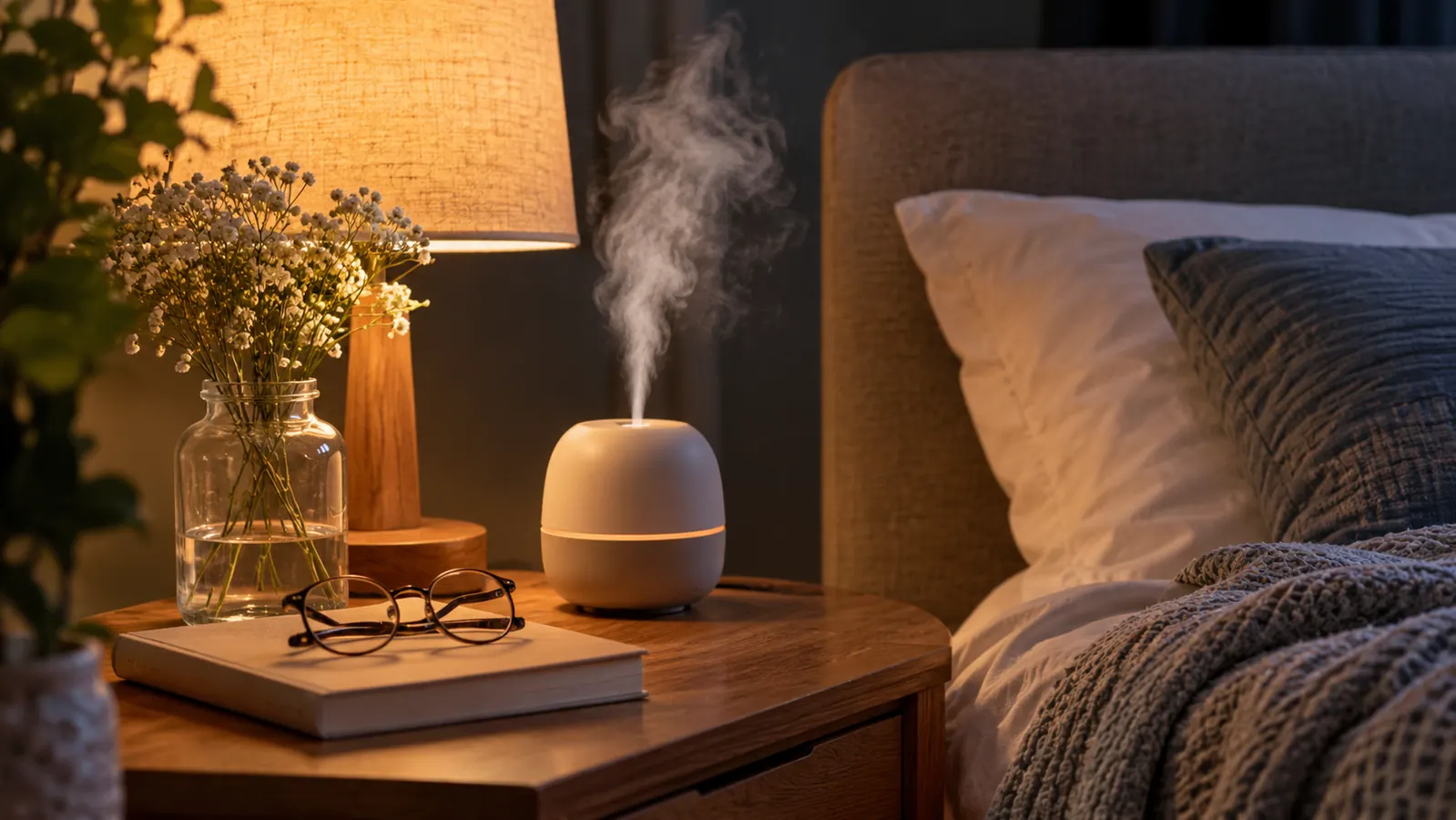
The main bedroom in our 1950s ranch has one lamp on my side and a stack of library books that never gets shorter. For years that was the whole wind-down routine: read until my eyes quit, turn off the light, listen to the furnace kick on in the basement. I did not want a gadget on the nightstand. What I wanted was a way to make the last hour of the day feel different from the first, and a candle made me nervous about falling asleep with a flame going. So in the first week of February I bought the ASAKUKI 300ml essential oil diffuser with my own money, and I have run it most nights since.
Nine months is enough time for a small appliance to stop being interesting and start being furniture. That is the stage I am writing from. I will not tell you it changed my health or fixed my sleep, because it did neither. I will tell you what it smells like in a bedroom smaller than the 200 square feet the listing gives, how loud it is at 10:30 at night, what the remote is like to live with, and how much upkeep a 300ml tank actually asks for. If you are setting up one calm corner and want to know whether this earns the space, that is the question I can answer.
The Quick Verdict
A simple 300ml diffuser that scents one bedroom and asks for a weekly wipe. The remote is easy to misplace and the scent will not carry down the hall, but after nine months it still earns its spot on my nightstand.
Amazon Check Today's Price →One Small Machine, One Hour of Calm Before Sleep
The ASAKUKI holds 300 ml, runs on 5 watts, and shuts itself off when the water runs low. That is the whole job, and it does it without asking for much.
Amazon Check Today's Price on Amazon →How I've Used It
The diffuser sits on the nightstand on my side of the bed, next to the lamp and a coaster that has become a ring catcher. I fill it after supper, add three drops of lavender or cedarwood, and switch it on when I go up to read. My husband Dale goes to bed earlier and gets up at 5:30, so the hour between 9:30 and 10:30 is mine. The diffuser runs for that hour, then I switch it off and go to sleep. That is the entire routine, and it has not changed since February.
This is the first diffuser I have owned. Before it, I used nothing. I am not a person who buys a gadget for every room, and I did not want something that blinked or beeped or needed a phone. What sold me was the ordinary list: a 300ml tank, a cord, a remote, and a shut-off for when the water runs out. I have never used the light colors for more than a minute of curiosity, and I have never used the timer beyond a test. The mist and the off switch are the only controls I touch.
I clean it every Sunday, which takes about four minutes. I unplug it, lift the top, pour out whatever is left, wipe the inside with a soft cloth, and set the pieces on a towel to dry. In nine months I have not had a leak, a cracked tank, or a morning where I found it running dry and hot. I have let it run out of water twice, and both times it shut itself off before I noticed. That matters more to me than any light setting.
The First Week: Find the Remote Before You Fill It
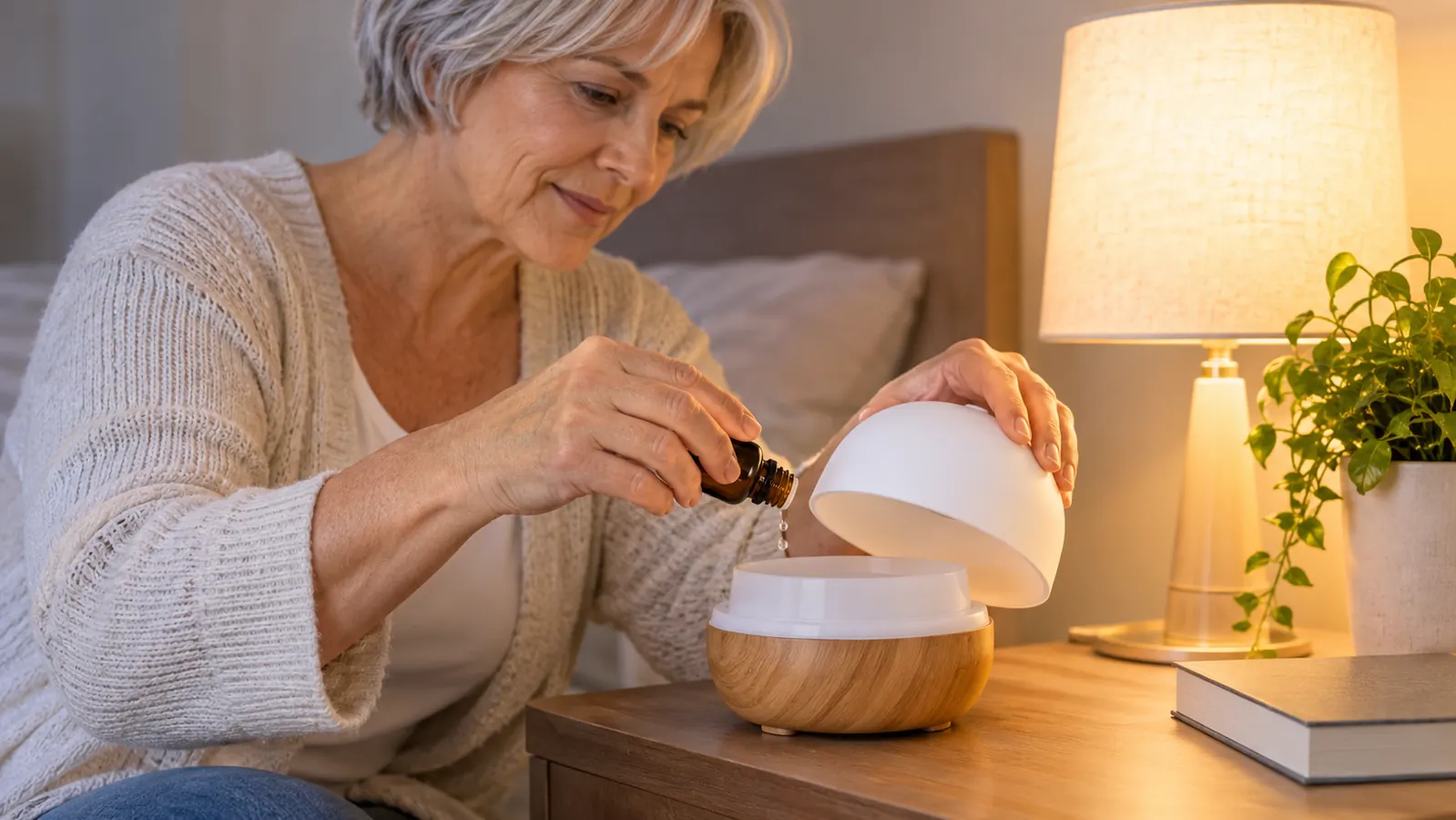
The first thing to know is that the remote and the power adapter are packed inside the water tank. The manual says so, but I still nearly threw the box out with them inside. Take the top off, look in the tank, and shake the packing over a towel before you do anything else. The adapter is small, the remote is smaller, and both are easy to lose in a recycling bin.
The first night I filled it to the mark, added three drops of lavender, set the mist to a lower setting, and left the light off. The scent reached the pillow within a few minutes. It was not a candle smell, and it was not the sharp smell of a cleaning product. It was softer, more like a drawer of dried flowers. Dale asked if I had been baking. I took that as a good sign.
The first week was mostly me learning where to put it. On the nightstand it misted toward the bed and left a faint damp patch on the book jacket if I aimed it wrong. I turned the top so the mist went toward the room instead of the pillow, and that solved it. I also learned to fill it before I got into bed. Getting up to refill a diffuser at 10:20 defeats the purpose of a wind-down routine.
How Far the Scent Actually Travels in a Bedroom
The listing gives a floor area of 200 square feet. Our main bedroom is smaller than that, and with the door closed the lavender fills the room but not the closet. With the door open it reaches the top of the stairs and stops. If you want the whole house to smell like a spa, this is not the machine for that. If you want one room to smell like the room you read in, it is enough.
The 300ml tank is the right size for an evening. I do not measure oil with a dropper. I use three drops for lavender and four for cedarwood, which is a stronger oil. The first twenty minutes are the strongest, then the scent settles into the background. By the time I turn it off, the room smells like the oil but not like a candle store. If I want more, I add a drop. If I want less, I use the lower mist setting.
I have tried it with the door open and the ceiling fan on, and the scent thins out fast. That is not a fault. A diffuser is not a whole-house humidifier, and I would rather have one room that smells good than a hallway that smells faintly of something I cannot name. The ASAKUKI is honest about its size. It scents a bedroom, a reading nook, or a small office. It does not scent a ranch house.
Noise and Light at 10:30 PM
The diffuser is not silent. It makes a soft water sound, like a small fountain two rooms away. On the low mist setting I can hear it when the house is quiet, and I cannot hear it once I am reading. Dale says he cannot hear it from his side of the bed. The furnace in the basement is louder. If you need absolute silence, this will not give it to you, but it is gentler than a box fan and easier to ignore than a clock ticking.
The light is the part I use least. It has seven color options and multiple light settings, and the remote will cycle through them. I tried the colors the first week, decided I preferred the lamp, and have run it dark ever since. If you like a small glow across the room, the light is there. If you do not, you can turn it off and forget it. The remote also handles the mist and the timer, which is handy when I am already in bed and do not want to sit up.
The shut-off is the feature I trust most. It has run dry on me twice, both times because I filled it early and read longer than usual. Each time it stopped on its own before the tank was hot. I still unplug it every Sunday, and I still check the water level before I switch it on, but I do not worry about it the way I worried about a candle. That is the trade I wanted: a small, quiet thing that does not need my attention once it is running.

Nine Months of Upkeep: The Sunday Wipe
The tank is plastic, BPA free according to the listing, and it shows a faint film after a week of tap water. That is normal for any humidifier or diffuser I have owned. The fix is a soft cloth and warm water, not a shelf of special cleaners. I wipe the inside, rinse the top, and let both air dry on a dish towel while I do the rest of the Sunday chores. I do not use vinegar unless I see a white ring, and I have seen one twice.
I have not had to buy anything for it besides oil, which is one reason I chose it. The 300ml tank is more than I need for an hour, so I pour out the leftover water in the morning and wipe the rim. That sounds fussy written down, but it takes less time than emptying the dishwasher. The routine is the price of a clean tank, and a clean tank is the difference between a room that smells like lavender and a room that smells like old water.
After nine months, the unit looks like it did in February. The plastic has not yellowed, the cord is not frayed, and the remote still works from the pillow. The top sits flush, and the mist is steady. I would not call it furniture. It is a small appliance, and it looks like one. But it is a small appliance that has not given me a reason to replace it, which is more than I can say for the last three coffee makers.
What I Would Change After Nine Months
I would make the remote bigger and give it a home. Mine lives in the nightstand drawer, and twice I have found it under a book. I would also put a small line on the tank that is easier to see at night. The fill mark is there, but in a dim bedroom I have topped it up by feel more than once. These are small complaints. They are the kind you make about a thing you use every day, not the kind that make you return it.
I would not change the size, the mist, or the shut-off. I would not add a phone app, because I do not want to open an app to go to bed. The light colors are wasted on me, but they are easy to ignore. If ASAKUKI made a version with a simpler light, I would look at it. Until then, this one does the job.
What I Liked
- 300ml tank covers an evening of reading without a refill
- Waterless auto shut-off means I do not have to think about it once it is running
- Multiple mist settings let me choose a light scent or a stronger one
- Remote controls mist, light, and timer from the bed
- Simple weekly wipe, and I have not had to buy anything besides oil
- Small footprint on a nightstand, and it runs on 5 watts
Where It Falls Short
- Scent stays in one room and does not carry down the hall
- Needs a weekly wipe and a morning pour-out to stay fresh
- Remote is small and easy to misplace
- Seven light colors are more than I need, and the plastic body looks like an appliance
- Not silent, just quiet
Nine months in, the routine has not changed: fill the tank, three drops of lavender, switch it on, read for an hour. The only thing the ASAKUKI has ever asked of me is a Sunday wipe.
Who This Is For
This is for the person who wants one room to feel different at the end of the day. Maybe it is a bedroom, a reading corner, or the small room where you stretch in the morning. You want a scent you chose, a machine that shuts itself off, and a remote so you do not have to get up. You are not trying to humidify a whole house or solve a health problem. You want a quiet ritual that takes two minutes to set up and four minutes a week to keep clean. The ASAKUKI fits that job.
It also suits a guest room or a small home office, anywhere the door closes and the space is under 200 square feet. If you already have a lamp you like, this will sit beside it without asking to be the center of attention. That is what I wanted: a background comfort, not a conversation piece.
Who Should Skip It
Skip it if you want the scent to travel beyond one room. Skip it if you want a piece that looks like pottery or glass and can sit on a shelf as decor. The body is plastic and it looks like a small appliance. Skip it if you know you will not wipe the tank. A diffuser that sits with old water is worse than no diffuser at all. And skip it if you want to control everything from your phone or set a schedule for the week. This one is controlled by the buttons and the remote, and that is the whole system.
If you want a diffuser that runs all night, this will do it, but you will be refilling a 300ml tank more often than you like. I run mine for an hour, not eight. If your idea of calm is a candle you can light and forget, this is not that either. It is a small appliance with water in it, and it needs the small amount of care that water always needs.
If Your Bedroom Needs One Calm Hour Before Sleep
The ASAKUKI 300ml diffuser holds enough for an evening, shuts off when the water runs out, and has run on my nightstand for nine months without a problem. It will not scent the whole house. It will make one room feel like the end of the day.
Amazon Check Today's Price on Amazon →