
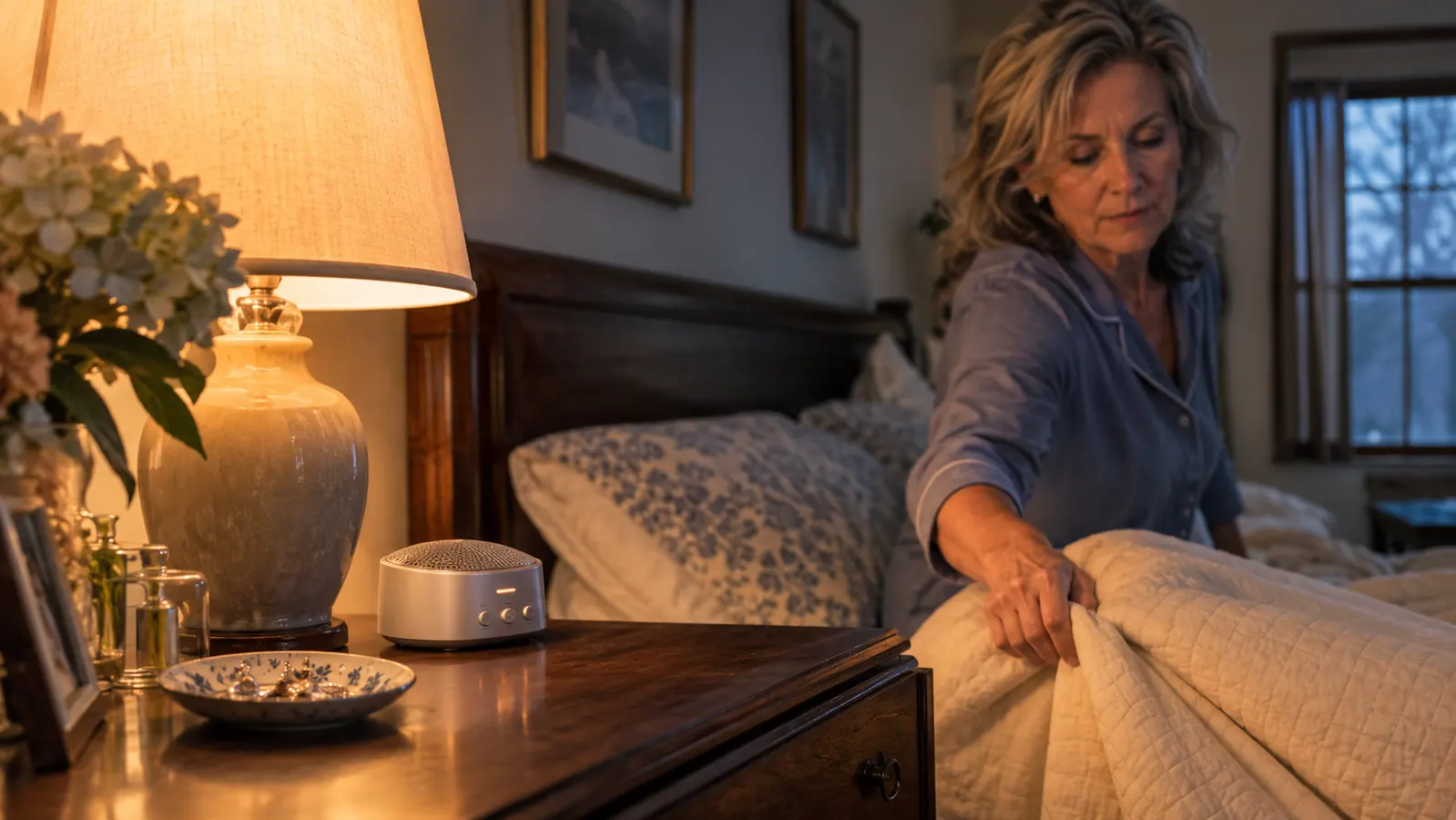
The furnace in our basement sits directly under the hallway floor. When it kicks on it makes three sounds in a row: a thud, then a whoosh, then a low hum that runs for about four minutes. For twenty years that was simply the sound of our house in winter. Then I retired from the school library, stopped setting an alarm for 6 a.m., and started hearing it.
I tried the usual advice first. I closed the bedroom door. I put a rolled towel along the bottom of it. What finally worked was the least clever option available: a small sound machine on the dresser, running all night. It is a Magicteam machine, bought in the first week of February with my own money, and it has been on that dresser every night since. Here is what I would tell a friend about setting one up, in the order I would tell it.
The furnace runs four minutes. This runs all night.
One small machine on the dresser, one sound, one volume, set once and left alone. That is the entire setup in our bedroom.
Amazon Check Today's Price on Amazon →Step 1: Write down what actually wakes you
The mistake I made first was shopping before I had a list. I spent an evening reading listings, comparing sound menus and sizes, and I could not have told you what I was trying to cover. So before you spend anything, spend a week with a pencil and a scrap of paper on the nightstand.
My list had four things on it. The furnace at 5:40. Dale's alarm at 5:30, which he snoozes twice. The newspaper delivery car in the driveway at 5:15, which is louder than it has any right to be. And the compressor on the kitchen refrigerator, which comes through the wall at the head of our bed. Only one of those is a big noise. Three of them are small noises that happen at the wrong hour.
That week I wrote down the time next to each entry, because the time turned out to be the useful part. A noise at 2 a.m. is a different problem from a noise at 5:40, and it needs a different answer. The 2 a.m. ones wake you out of deep sleep and you carry them around all the next day. The 5:40 ones just end your night twenty minutes early. Once the times were on paper I could see that I was not really fighting a noisy house. I was fighting a ninety-minute window before dawn.
Dale's list was different from mine, which surprised me. He never mentioned the refrigerator. He had been sleeping through that compressor for twenty years without registering it at all. Two people in the same bed can be bothered by completely different things, and the machine has to cover the louder list, not the fairer one.
That distinction matters, because a sound machine is good at one job and poor at another. It covers steady or repeated sound well. It does not do much for a single sudden bang, like a door slamming or a car door in the street. If your list is mostly rhythm and hum, a machine will help and you will notice it the first night. If your list is one loud crack in the dark, the machine only takes the edge off, and you should know that going in.
Step 2: Put the machine between you and the noise
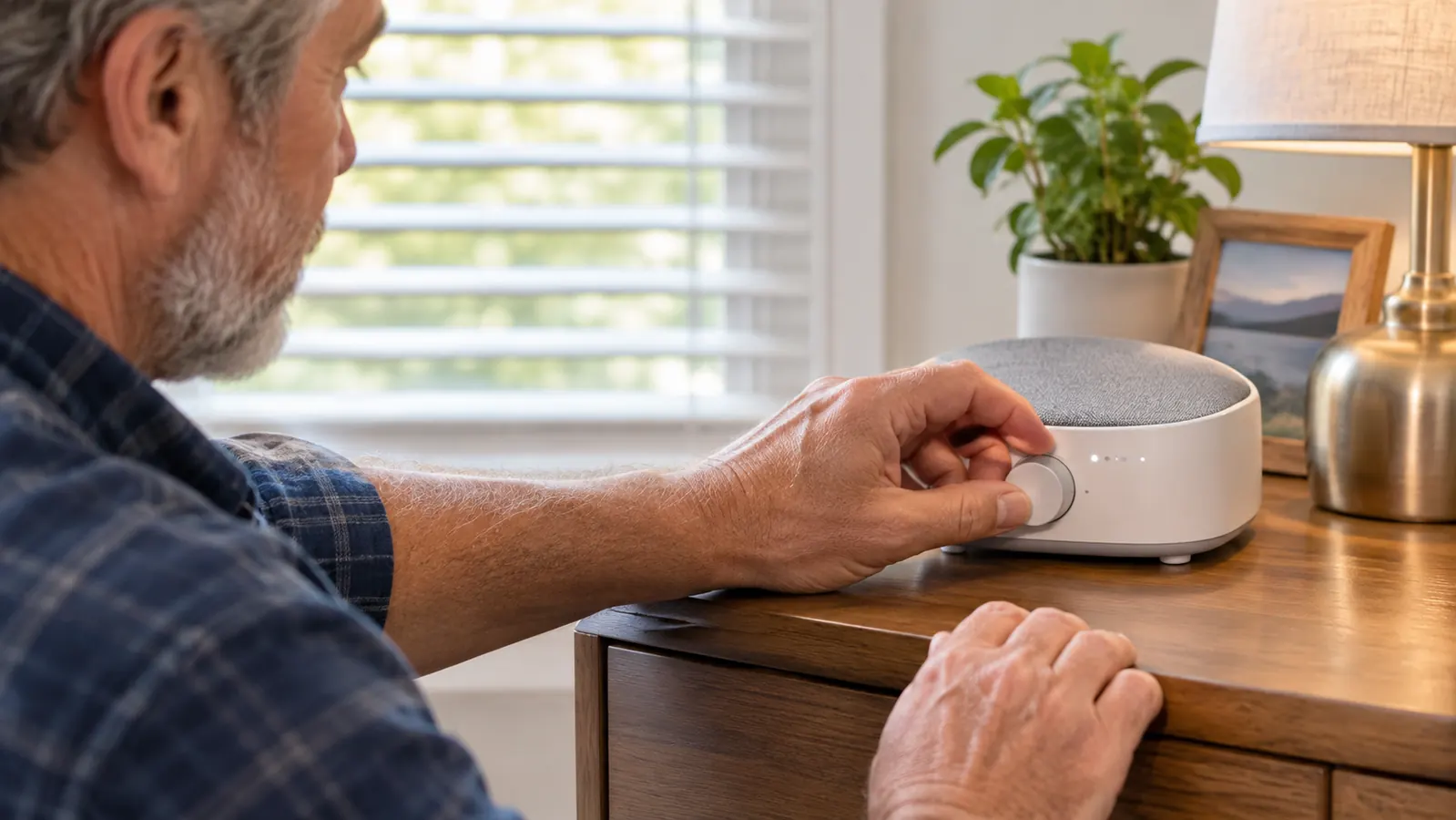
Where the machine sits matters more than how loud it goes. Sound thins out with distance and with a closed door, so the useful position is on the noise side of the room, not next to your ear. Ours is on the dresser, which sits between the bedroom door and the foot of the bed. The machine is closer to the hallway than we are, so the hallway noise has to get through it first.
The instinct is to put it on the nightstand, six inches from your head. All that does is make the machine itself the loudest thing in the room. You end up with two noises instead of one, and the new one has a cord.
I know the nightstand theory is wrong because I tested it. The first week I put the machine on my side of the bed, about a foot from my head, and set it low. The furnace did go away. What replaced it was every swell and shift in the track, which I could hear in detail, and by the fourth night I was lying there listening to the sound designed to stop me listening. I moved it to the dresser and slept better at the same volume. Distance from your ear is a kindness to the machine.
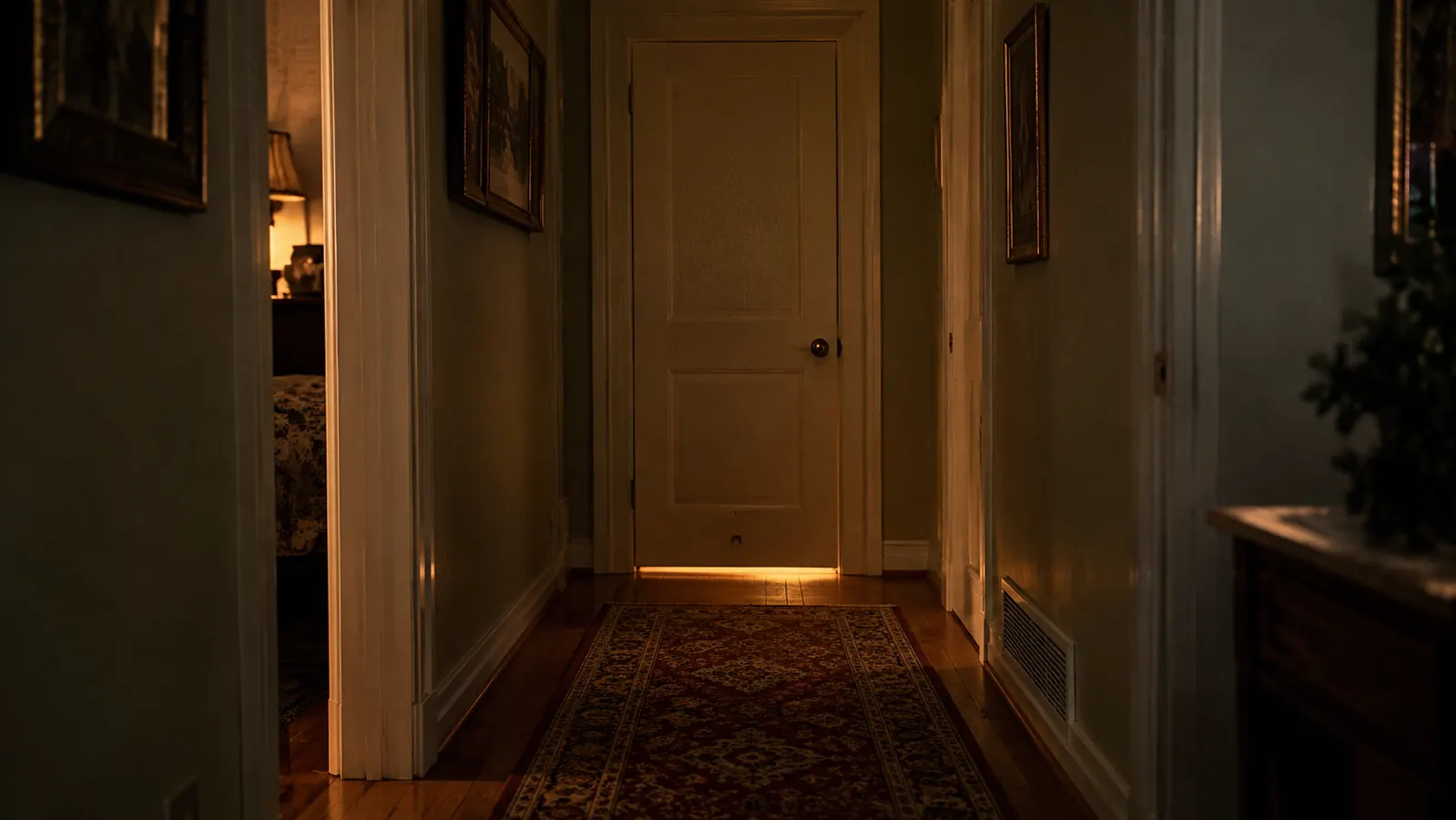
I will be honest about the door. Ours is closed at night, which means the machine and the furnace sit on opposite sides of it. A closed door cuts both ways. We like the door closed, so we accepted that, and the machine is near enough to the gap at the bottom that it still does its job. If your door is open, you get more out of the same setting, and you can run it lower.
Two practical notes on placement. The machine has no battery, so the spot you pick needs an outlet nearby. It runs on the adapter or on a USB cord, but it has to be plugged in, which is worth knowing before you fall in love with a shelf across the room. And the Magicteam is small, 2.64 by 2.64 by 2.83 inches and 5.76 ounces, so it does not need furniture of its own. Ours shares the dresser with a lamp and a dish of earrings and does not crowd either. The body is ABS plastic, so a dry cloth every couple of weeks is the whole maintenance routine.
Step 3: Choose one sound and stop auditioning
There are 20 sounds in the machine: white, brown, pink and blue noise, plus fan, brook, rain, ocean, bird and bonfire. That reads like a menu, and the temptation is to work through it night by night like a radio dial. Do not. Pick one, live with it for a week, and only then decide whether it is the wrong one.
The sounds are non-looping, which is a plain feature that matters more than it sounds. A short clip that repeats every thirty seconds becomes its own annoyance, because your ear learns the seam and then waits for it. The tracks in the Magicteam run long enough that I stopped noticing a pattern after the first few nights. I cannot tell you the loop length, only that I never found the join.
We settled on the fan sound. That is partly history, since we ran a box fan in that bedroom for years, and the fan track is close enough that neither of us had to relearn how the room sounds. On nights when the fan feels flat I switch to rain, which has more texture and does a better job on the refrigerator compressor. Dale has never once commented on either, which from him is high praise.
Give a track a fair week. My first night on rain I thought it sounded like a recording of rain rather than rain, which is what it is, and I nearly pressed on to the next sound. By Thursday I had stopped hearing it as a recording at all. Everything sounds like a machine on night one, which is a small argument for not judging any of the sounds until you have slept on it three or four times.
One honest note. The bird and bonfire tracks are pleasant, but they are not covering sounds. They have variation and peaks, and variation is exactly what pulls your attention back into the room. Save those for a rainy afternoon in the living room, not for 2 a.m.
Step 4: Set the volume just under the noise
There are 32 volume levels, which is more resolution than most people need, and it means you can find a setting instead of settling for one. My method took about three nights to get right.
Start at the lowest level you can hear from the bed. Turn it up until the furnace disappears. Then back off two clicks. That last part is the one people skip. If the machine is the loudest thing in the room, you have traded one noise for another and added a cord.
The test I use is simple. If I find myself listening to it, it is too loud. The right setting is the one where you notice the room has gone quiet and cannot say why. It should sit under everything, not on top of it. Ours is somewhere in the middle of the range, and I have not moved it in nine months, through summer and winter both.
The Magicteam will go louder than that. With the bedroom door open I can hear it out in the hallway, and I would not want to sleep beside it at that level. This is a small machine with a small speaker, and the upper levels get thin and sharp before they get impressive. Nobody needs the top volume level in a bedroom.
Step 5: Set the timer and the memory once, then leave it alone
The machine has a timer with 1, 2 and 3 hour settings, and a memory function that holds your sound and volume for the next time you switch it on. Both are worth understanding before your first night, because they solve two different problems.
I tried the 1 hour timer first, on the theory that I would be asleep long before it mattered. I was. Then it shut off at 11:30, and at 5:40 the furnace came through a silent room and I was awake for good. For our house the timer is the wrong tool, because our noise happens at dawn, not at bedtime. If your noise is falling asleep with a television going in the next room, or traffic on the street, the timer is exactly right and you will want it every night.
The memory function earns its place more quietly. It means the machine comes back to the fan sound, at my level, without me hunting for buttons in the dark. I unplug it to dust the dresser every couple of weeks, plug it back in, and it is already where I left it. That sounds like a small thing. It is a small thing I would miss.
There is one more setting worth knowing about, and it is not on the machine. It is the order you do things. I switch it on before I get into bed, not after. Reaching over in the dark to start it, at the volume it remembers, is a jolt to an otherwise quiet room. Two minutes of it running while I turn back the covers and set my book down, and the room is already the room I want to be in. Dale does the same now, without being asked, which never happens.
There is nothing else to do to it. It is a small plastic box that plugs in and plays a sound, with no moving parts, no filter, no water tank, no app to open and no account to make. After nine months that is the part I appreciate most. A thing meant to help you wind down should not need managing.
What Else Helps
Sound covers sound, but a few cheap fixes made the machine's job easier. We had an old runner rolled up in the basement, and it now lies on the hallway floor above the furnace, which brought the thud down to a mumble. The register cover was vibrating against the floor, and a folded piece of cardboard wedged under one edge stopped it. The towel along the bottom of the bedroom door stayed, because a door gap lets in more noise than people believe.
The one thing I would not skip is fixing the rattle. A machine is very good at hiding a steady hum and poor at hiding a buzz, and a loose register will buzz straight through the rain sound no matter how high you set it. Deal with the moving parts first, then choose your volume.
And if your noise problem is a banging pipe, or a neighbor's television at a volume no small box will cover, I would rather say plainly that this approach will disappoint you. Our furnace hum is the size of problem a dresser machine handles. Yours may not be.
The trick is not to hear the machine. It is to hear nothing where the furnace used to be.
Set once in February, untouched ever since
Rain or fan, a level in the middle of the range, plugged in by the dresser. Nine months on, it is the least interesting thing in our bedroom and the first thing I would replace if it quit.
Amazon Check Today's Price on Amazon →