
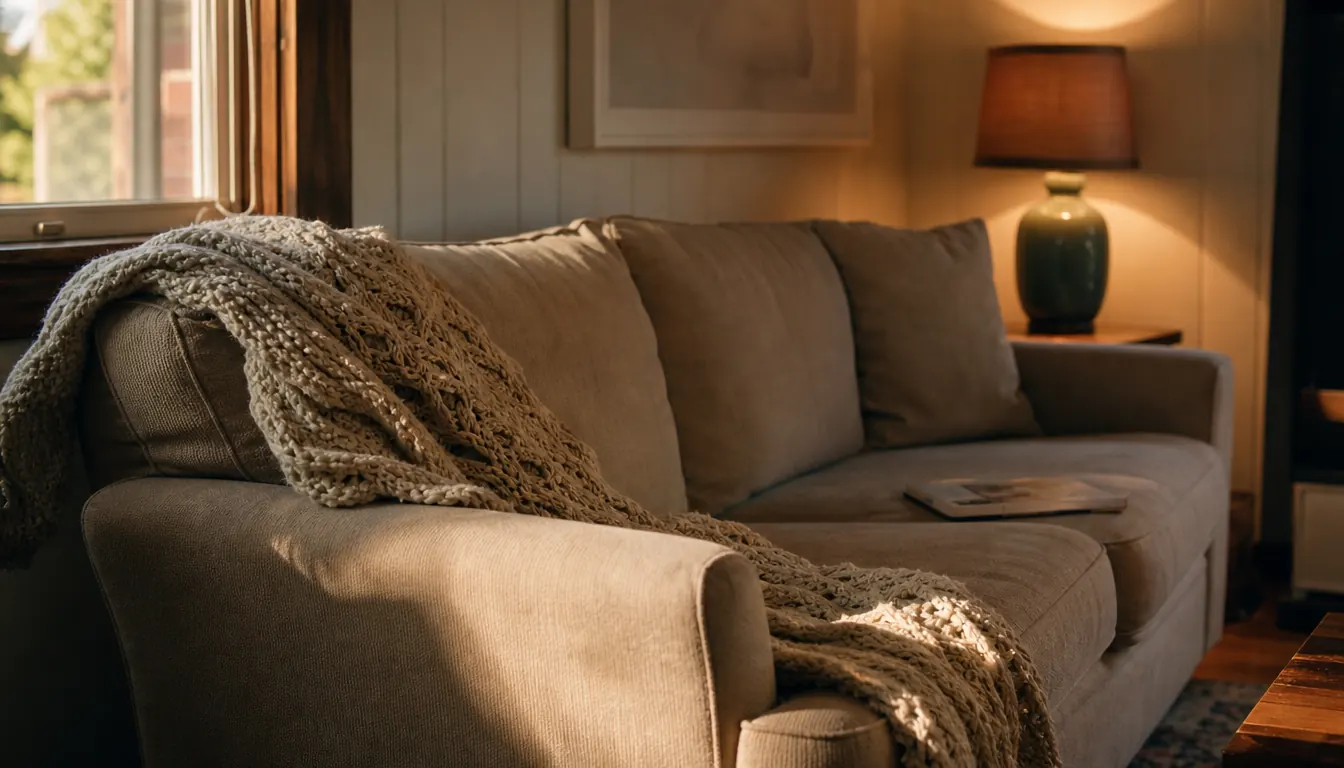
Most throws end up in one of two places. Balled on the arm of the sofa like laundry waiting to be dealt with, or folded so square and tight it looks like a hotel towel nobody is allowed to touch. Neither one makes a room feel calmer. One looks like a mess you are ignoring. The other looks like a rule.
I did both for years. We live in a 1950s brick ranch outside Rockford, three small bedrooms, and for most of my married life the only blanket in the living room lived folded in the hall closet. The sofa looked like a piece in a furniture showroom, which is a polite way of saying nobody wanted to sit on it. Then in January I turned the smallest bedroom into a quiet room, a reading chair, a mat, a small shelf, and I bought a few things to make it feel like somewhere to breathe out. One of them was the L'AGRATY chunky knit throw, 50 by 60 inches. It is the piece that fixed the living room too, which I did not expect. Here is what nine months of actually using it taught me.
The throw that made our living room look lived in instead of staged
50 by 60 inches, medium weight, machine washable, and it moves from sofa to reading chair without a fuss. Mine has been in daily use since February.
Amazon Check Today's Price on Amazon →Step 1: Give the throw a job before you give it a spot
A throw needs a job before it needs a spot. Otherwise it becomes one more object to move out of the way when you vacuum. So decide first. Is this the blanket you actually pull over your knees at nine o'clock, or is it there to make the sofa look finished? Mine is both, but the sitting came first, and that order matters. A throw you use gets draped differently than a throw you only look at, and the used version is the one that makes a room feel lived in.
The practical version of that decision is knowing where you sit. In our living room it is the left end of the sofa, closest to the lamp and the window. That is where the L'AGRATY throw lives, over the arm, close enough to grab without standing up. If a chair is where you land, put it there instead and leave the sofa alone. One throw in one honest spot beats two throws draped prettily in rooms nobody sits in.
Before I bought anything I measured the arm of our sofa with a tape measure from the junk drawer. Nine inches across the top, twenty two inches from the front of the arm to the back cushion. That sounds fussy. It took ninety seconds and it told me a 50 by 60 throw would hang about a foot and a half down the outside of the arm, which is the amount that reads as intentional rather than accidental. Our old gray fleece was 50 by 60 as well and it never hung right, because it was too light to stay where I put it. Weight matters more than size in this one small decision.
One thing before you drape anything. Clear the surface it is going on. Not a deep clean, just the pile of mail, the remote that lives on the cushion, the second throw you never liked. A chunky knit is a texture, and texture reads as clutter when it is sitting beside four other things competing for the same square foot. I moved a stack of magazines to the shelf and the throw immediately looked better than it had any right to.

Step 2: Drape it, don't spread it
The instinct is to spread a throw flat across the whole sofa, corner to corner, like a bedspread. Do not. It reads as a slipcover, it slides every time someone sits down, and it makes the sofa look wider and flatter than it is. A throw is supposed to look like it landed there, not like it was assigned there.
Pick one anchor instead. Over the arm at one end, or over the back corner if your sofa has a low back. Let about a third of the throw hang down the outside and the rest sit on the seat. You want three distinct areas: the part hanging, the part resting on the arm, and the part falling onto the cushion. That unevenness is what makes a knit look soft rather than stiff. It takes about ten seconds and it is the only part of this whole article that matters if you skip everything else.
Scrunch a little. This is the part that feels wrong to people who like things tidy, and I am one of those people. A chunky knit has a loose, open weave and it looks best with a few folds that are not quite even. Pull it into a rough V where it hangs. Nudge one edge up two inches so it is not parallel to the floor. That small asymmetry is the difference between a photograph in a catalog and a corner somebody actually uses.
One cold evening in February I draped it the flat way and then turned on the ceiling fan. Two hours later it was on the floor. A flat drape has nothing to hold it. The over the arm drape does, because the arm is a shape the knit can settle around. If your sofa has no arms at all, a bench or an ottoman, use the back corner instead and tuck the tail under. And if you run a fan in the evening, put the heavy fold on the side facing the middle of the room. That is the side the air reaches first, and it will not move again all night.
Step 3: Fold it in thirds for the flat look
Some days you want the neat version. A folded throw sitting on the seat, or across the foot of the bed. Here is the fold that works with a knit this heavy. Lay it flat, fold it in half the long way so it becomes a long rectangle, then fold that rectangle in thirds. You end up with something roughly the size of a bath towel, and because the throw is a medium weight at about four pounds, the fold holds without sagging or creeping.
Set it down with the folded edge facing out, not the open edges. Same on a bed. Across the foot of the bed, folded in thirds, is the version I use when the main bedroom needs to look like an adult sleeps there. Fifteen seconds, and it holds all day, which is more than I can say for most things in this house.
If you want it to stay put on a seat cushion, tuck the bottom edge an inch or two under the cushion. That keeps the fold from migrating when somebody sits down, and it hides the raw edge without pinning or clipping anything. I tried a decorative strap once. It lasted one evening and then lived in a drawer.
Fifteen seconds to fold, and it holds all day. It is also the one thing in the living room my husband Dale has never once moved out of his way.
Step 4: Let it travel in the evening
Around eight I move to the quiet room, and the throw goes with me. This is not a design decision, it is just what happens, and it is the reason I stopped buying decorative pillows years ago. A throw that can move is a throw that earns its space. Anything that has to stay in one place to look right is furniture, and I already have enough furniture.
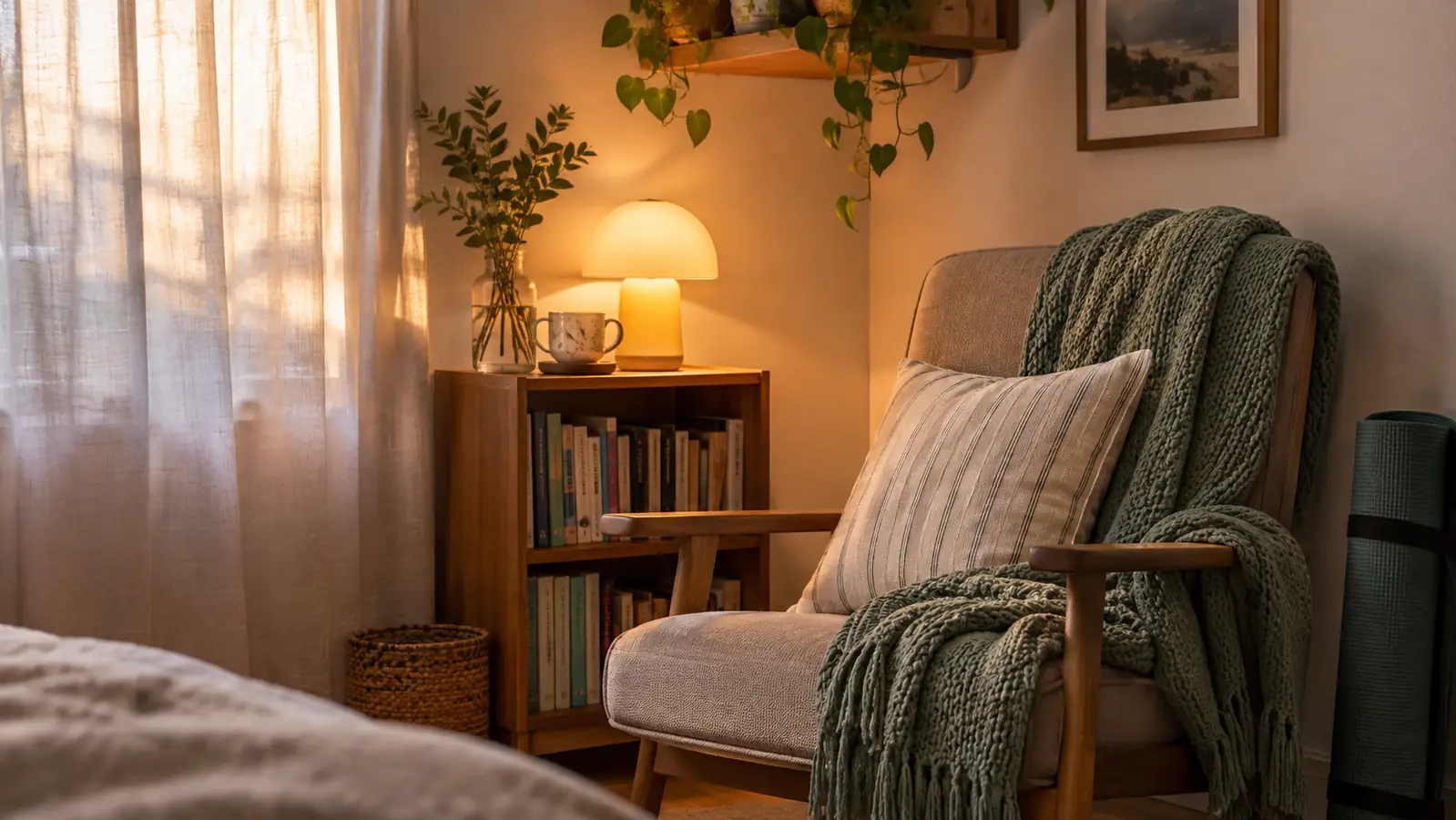
Over the back of a reading chair it looks different than it does on a sofa. The chair has a tall back, so I drape it over one shoulder of the chair and let it fall down the side, then pull it across my lap once I sit. The open knit means it does not get too warm. That matters if you are the sort of person who reads for an hour and then wonders why they are overheating. I am that person.
Dale gets up at five thirty, so my evening hour is the only quiet one in this house. I noticed in March that I had stopped folding the throw at night at all. I just pull it up and leave it where it falls. That is the real test of whether a throw is working. If you are still arranging it after you sit down, it is in the wrong spot or it is the wrong throw. Mine stopped needing arranging somewhere around the third week, and that is the most useful thing I can tell you about it.
In the morning it goes back to the sofa. Sofa to chair to sofa, that is the whole system. No basket, no folding marathon, no rules posted anywhere. If a throw is only allowed in one spot, it stops being part of the room and becomes part of the decor, and decor is the thing everybody quietly resents.
Step 5: Keep it clean without wrecking it
Chunky knits have a reputation for being fussy. The L'AGRATY throw has held up better than I expected. Once a week I take it outside and shake it hard. That is the whole routine most weeks. The open weave does not trap crumbs the way our old fleece does, and a good shake handles the rest. In nine months I have not once had to vacuum it.
For spots, a damp cloth and a drop of mild soap, dabbed and not scrubbed. Scrubbing a knit pulls the fibers and leaves a fuzzy patch that never quite matches the rest of it. I have done this twice, both times after a coffee cup, and both times it dried without a mark. Do not rub. Blot, and walk away.
It has been machine washed once, on cold, on gentle, and laid flat to dry on a clean sheet over the guest bed. Do not put a knit this heavy in the dryer. It will not fall apart, but it will lose the loft, and loft is the entire reason you bought it. The care instructions say machine wash and that is accurate, but cold, gentle and flat drying is the part that keeps it looking new. Nine months in, the corners have not pilled and it has not shed on the sofa.
The wash was in June, on a Saturday, because I wanted a day to spare in case something went wrong. Nothing did. It came out of the machine heavier and flatter looking, which is what wet knit does, and I laid it on that clean sheet over the guest bed with the ceiling fan on low. Dry by the next morning. The one thing I would do differently is not stretch a corner to square it up while it was still wet. I did, and that side dried a touch longer than the other. It evened out after about a week of evenings.
What Else Helps
The throw is the easiest thing in a room to get right, which is why it is worth doing first. But a throw on its own will not make a corner feel calm. Three other things did more work in our house than I expected, and none of them cost much.
Light, mostly. A lamp at the right height and low and warm changes how a throw looks more than the throw does. I keep a salt lamp on the small shelf beside the reading chair in the quiet room, turned down to its lowest setting in the evening, and it is the reason the knit looks soft instead of flat after dark. In the living room the lamp at the near end of the sofa does the same job. Overhead light flattens everything, including the thing you just spent good money on.
A chair you actually sit in, and somewhere to put a cup down. If the chair is uncomfortable, no amount of texture will make you use the room. And less of everything else. The largest improvement to our living room was not a purchase. It was taking three things off the side table. One throw, one lamp, one book, one cup. That is the formula, and it has not changed in nine months.
Ten seconds to drape, and the corner reads finished
50 by 60 inches, medium weight, machine washable on cold and gentle. Used daily since February and it still holds its fold.
Amazon Check Today's Price on Amazon →