
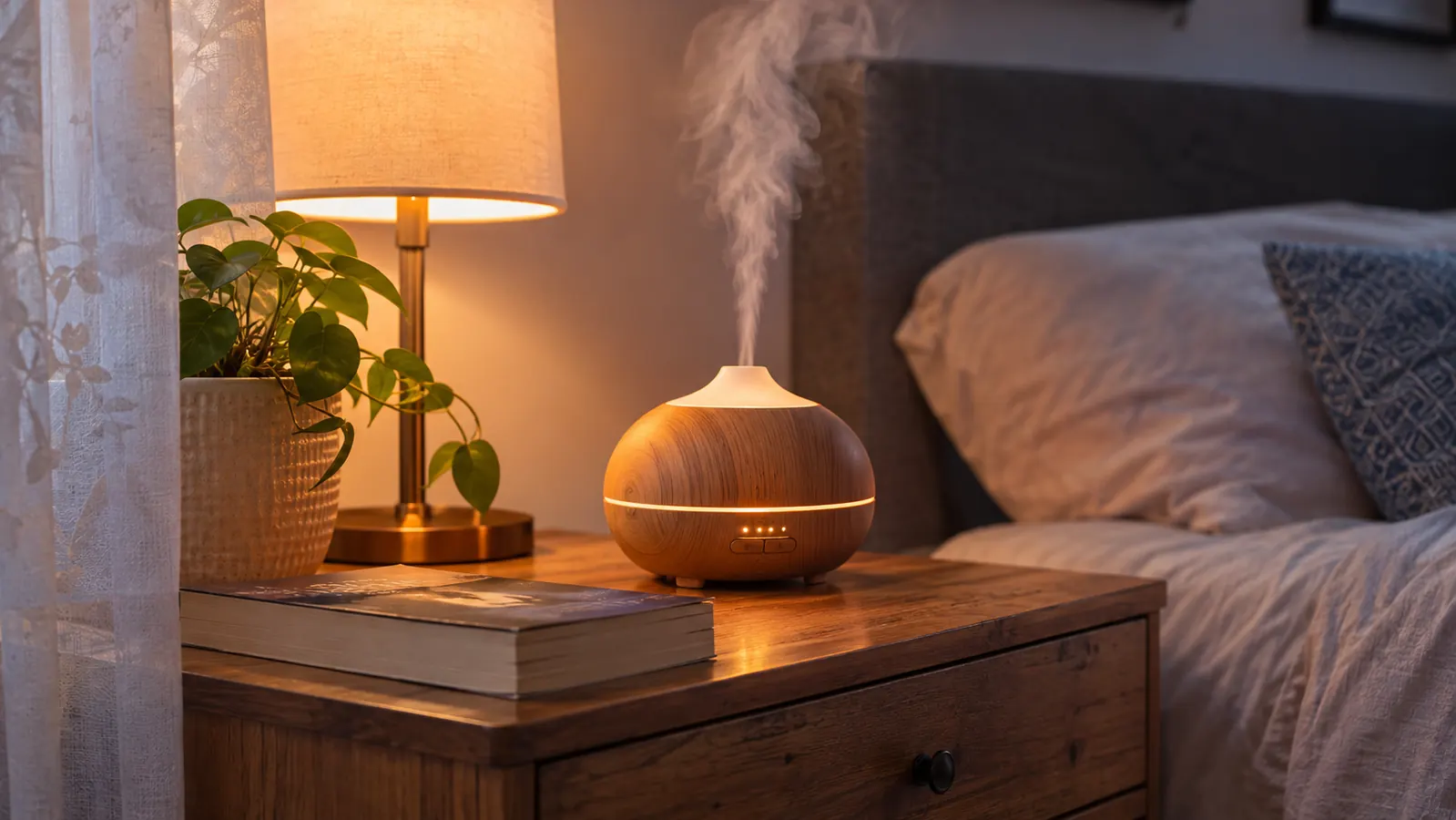
Most people who want a calmer bedroom start with the wrong thing. They buy a candle, or a new set of sheets, or a plant, and then nothing about the room actually changes. The overhead light still goes on at nine at night. The last twenty minutes of the day still happen standing at the kitchen sink or scrolling in bed with the lamp on. The room is the same room with one more object sitting in it.
What changed my bedroom was not a purchase. It was an order of operations. I put the pieces together in January in the small back bedroom of our 1950s ranch, the one that became my quiet room, and by the first week of February I had the same setup on my side of the main bedroom. The diffuser is the last thing in that sequence, not the first, which is why so many people buy one and then stop using it by March. This is the order I would do it again, built around the ASAKUKI 300ml diffuser that has been sitting on my nightstand for about nine months now.
The Piece That Ends the Evening Without You
The ASAKUKI runs on a timer you set from the remote, shuts itself off when the water runs low, and can be dimmed from bed. Everything else in the routine is yours to do. This part does itself.
Amazon Check Today's Price on Amazon →Step 1: Clear the Surface and Pick the Spot You Actually Sit or Lie Down
My diffuser lives on the nightstand on my side of the bed, and that location does most of the work. It is within arm's reach when I am lying down, which means I never have to get up to turn anything on or off, and it sits back from the edge far enough that I have not knocked it over in nine months. If you read in a chair instead of in bed, put it on the table beside the chair. The point is that it should be where the winding down already happens, not on a dresser across the room because that is where the outlet happened to be.
Second, decide what the surface is allowed to hold. My nightstand has the diffuser, one book, and a coaster. That is the whole list. Everything that used to collect there, the tissues, the hand cream, the stack of mail I was going to deal with, moved to the dresser. I am not a minimalist and I am not going to pretend that clearing a nightstand changed my life. What it did was make the diffuser the only thing in reach at ten o'clock, which is the reason I use it instead of thinking about using it.
The last part of this step is the outlet. The ASAKUKI is a corded diffuser, not a battery one, so you need a wall socket close enough that the cord reaches without stretching across a walkway. Five watts is all it draws, so it will not trip anything and it will not show up on the electric bill in any way you would notice. In our bedroom the cord runs behind the nightstand and I do not see it. If your nearest outlet is across the room, solve that before you buy anything, because a diffuser you have to unplug and move every night is a diffuser you stop bothering with.

Step 2: Unpack It Properly, Because Two Pieces Are Hidden Inside
I want to save you the twenty minutes I spent convinced I had been sent an incomplete box. The power adapter and the remote control on the ASAKUKI are packed inside the water tank, not in a separate bag rattling around the carton. You have to lift the lid and look down into the tank. The manual says so, in fairness, and I read the manual after I had already started a return.
Once everything is out, rinse the tank with plain water and let it air dry. Then fill it to the line the manual shows, not to the top. The tank holds 300ml. I fill mine to the marked line and that gives me a little over an hour of mist, which is roughly a chapter and a half for me. Overfilling does not buy you a longer evening, it buys you a ring of water on the nightstand and a tank that is harder to wipe out on Sunday.
The remote is the piece that makes this practical rather than fiddly. It controls the light, the mist mode, and the timer settings, so once everything is set up you are not leaning over the tank in the dark hunting for a switch. I keep mine in the top drawer of the nightstand, because a remote left lying on a flat surface migrates. The adapter goes in the wall, the cord goes behind the furniture, and that is the entire install. It took me under ten minutes once I stopped looking for a box that did not exist.
Step 3: Use Less Scent Than You Think You Need
Here is the mistake I made for the first two weeks. I treated the oil like it was the whole point, put in more drops than the instructions called for, and the bedroom smelled like a candle shop within an hour. It was not calming, it was loud. A diffuser does not need much to scent one bedroom with the door closed. Three or four drops of lavender is where I settled, and some nights it is two.
Lavender is what I use most, and cedarwood in the winter when the house already smells like the furnace. That is as far as I will go with recommending a scent, because scent is personal in a way that a lamp is not. What I would say is start with one bottle of something plain and inexpensive before you buy a set of six. If you do not like it in the diffuser, you have wasted one small bottle instead of a shelf of them.
The other thing about the tank is that it needs wiping out, not just rinsing. I empty whatever is left, wipe the inside with a paper towel, and let it sit open for a while on Sunday mornings. Once a week is enough for how I use it, which is about an hour a night. The 300ml capacity means I am filling it every day or two rather than twice a day, and that is the reason I would not go smaller than this for a bedroom. A 100ml diffuser is a desk diffuser. It is not an evening diffuser.

Step 4: Set the Light and Mist for Winding Down, Not for Show
The ASAKUKI has seven light color options and more than one light setting, and the temptation in the first week is to work through all of them. Do that in the daytime if you must. At night, pick one and leave it alone. I use the warmest, dimmest option and I have not changed it since February. A bedroom at ten at night should be dimmer than the rest of the house, and a diffuser cycling through seven colors is a small television on your nightstand.
Mist works the same way. There is more than one mist setting, and the lighter one is what I use for reading, because a heavy plume in a closed room puts enough moisture in the air that I notice it on the pages of a book. If you like to see a strong mist, the higher setting is there and it does what it says. There is no wrong answer in general, but there is a right answer for a bedroom, and it is the quieter one.
The feature I actually rely on is the waterless auto shut-off. I have fallen asleep mid-chapter more times than I will admit out loud, and every one of those nights the diffuser ran itself dry and stopped on its own. I have never come downstairs in the morning to a sputtering unit. That one function is the difference between something I run at night and something I would not feel comfortable leaving alone in a room.
Step 5: Put It on a Timer and Let It End the Evening for You
The remote carries timer settings, so the diffuser can run for a set stretch and then stop whether or not I am still awake. Mine is set for about an hour. Lights down, timer on, book open. When the mist stops, the room gets very slightly quieter, and that is my cue to put the book on the nightstand. It is a small thing and it works better than an alarm, because nothing is telling me to go to sleep. The evening is just closing on its own.
This is where the diffuser fits with the rest of the house, and where it does not. Dale gets up at 5:30 most mornings, and the furnace sits in the basement directly under the hallway, so our bedroom catches both noises. The sound machine on the dresser handles that. The diffuser has nothing to do with it. I bring it up because people assume the diffuser is supposed to fix a room, and it is not. It adds a smell and a low light. The sound is a different tool for a different problem, and so is the lamp.
What the routine has done is give the last hour of the day a shape. I go to bed around 10:30. Somewhere near 9:30 I fill the tank, set the timer, and sit down. That is nine months in and it has not gotten old, which for me is the real test of anything that gets to stay in a room. I have bought things for this house that I was excited about for a month at most. This one I still use without thinking about it, and that is the highest compliment I can pay a small appliance.
What Else Helps
The diffuser is one piece of a corner. The other pieces take less effort than you would expect and they matter more than the diffuser does. The first is light you can turn down. In the quiet room that is the salt lamp on the shelf by the chair, which is a light and nothing more, whatever the packaging wants you to believe. In the main bedroom it is just the small lamp on Dale's side. Either way, at nine o'clock the overhead light goes off and stays off. A diffuser under a bright ceiling light is a diffuser in a kitchen.
The second is sound. Not music, and not anything with words in it. The sound machine sits on the dresser and runs rain or a fan sound all night, which covers the furnace kicking on and the 5:30 wake-up. You do not need a machine for this part. A box fan works, and we ran one for years before the machine. The point is simply that the room should not contain a startle.
The third is something to do with your hands that is not a phone. For me that is a book in the chair with the throw over my knees, or ten minutes on the cushion on the floor most mornings. The diffuser runs while I do it and then stops. That is the whole arrangement, and none of it required a decorator or a weekend of work. It required deciding that one corner of the house was not going to hold anything else, and then being stubborn about it for a few weeks until it became the way the evening goes.
Nine months in, the routine is the same every night: fill the tank, set the timer, read for an hour, and it shuts itself off before I do.
One Hour of Lavender, Then It Turns Itself Off
The ASAKUKI holds 300ml, runs on a timer you set from the remote, and shuts down on its own when the tank runs dry. Fill it at 9:30 and stop thinking about it.
Amazon Check Today's Price on Amazon →