
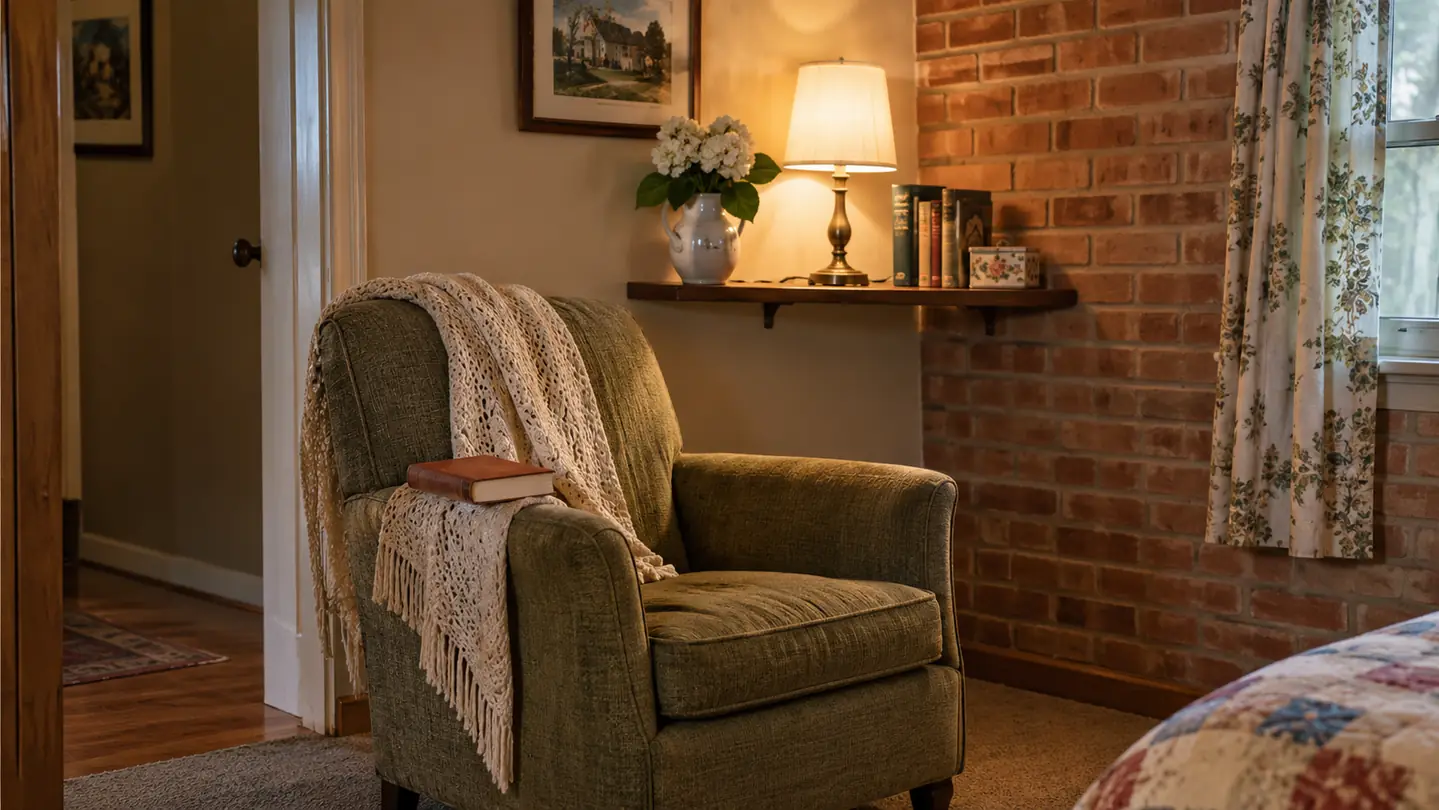
The corner of my smallest bedroom held a chair, a shelf, and nothing else for two years. I would walk past it on the way to the laundry and think, that would be a nice place to sit. Then I would not sit there. Not once. The chair was fine. The shelf was fine. It was the ceiling light overhead, a single bulb that turned the whole corner the color of a hospital corridor, that kept me walking.
I am not a decorator. I am fifty-eight, retired from a school library in Rockford, Illinois, and what I wanted was one room in this 1950s ranch house that existed only for winding down. No desk. No paperwork. Somewhere to read for twenty minutes before bed without feeling like I should be doing something useful. What finally made that corner work was not the chair and it was not the shelf. It was the light, and the light turned out to be one small Himalayan Glow salt lamp with a touch dimmer, sitting on the shelf beside me, usually on its lowest setting.
The lamp that made an unused corner usable
The Himalayan Glow salt lamp with the touch dimmer switch is the one living on my shelf, on the lowest setting most evenings since February. Today's price is on the listing.
Amazon Check Today's Price on Amazon →What follows is the order I actually did this in, spread over about a week at the end of January and then nine months of living with the result. None of it requires a contractor, and if you already own a decent chair you can finish the whole thing on a Saturday afternoon and be sitting in it that night.
Step 1: Choose the corner by when you will use it, not by how it looks
Most people pick the prettiest corner, or the one nearest a window, or the one that shows best from the hallway. My quiet room gets almost no direct afternoon sun, and for a long time I treated that as a disqualification. It turned out to be the reason the room works. If a corner is bright at four in the afternoon, you will use it at four in the afternoon, and four in the afternoon is not when I need help winding down. I need help at nine thirty at night.
Ask yourself two questions before you move anything. Where will I actually sit at the end of the day, and what is between that spot and the rest of the house? The second one matters more than people expect. My chair faces away from the doorway, so I cannot see the kitchen from it. That is the entire trick. A chair facing a doorway is a chair you sit in while watching for someone to need something from you.
Then clear the corner completely. Everything comes out, including the things you are sure you will get around to dealing with. Put back only what belongs to sitting down and reading. In my case that meant a chair, a small shelf on the wall, a floor cushion, and the lamp. The box of tax receipts went to the basement. So did the sewing machine I have moved three times and used once.
Step 2: Fix the light before you spend a dime on anything else
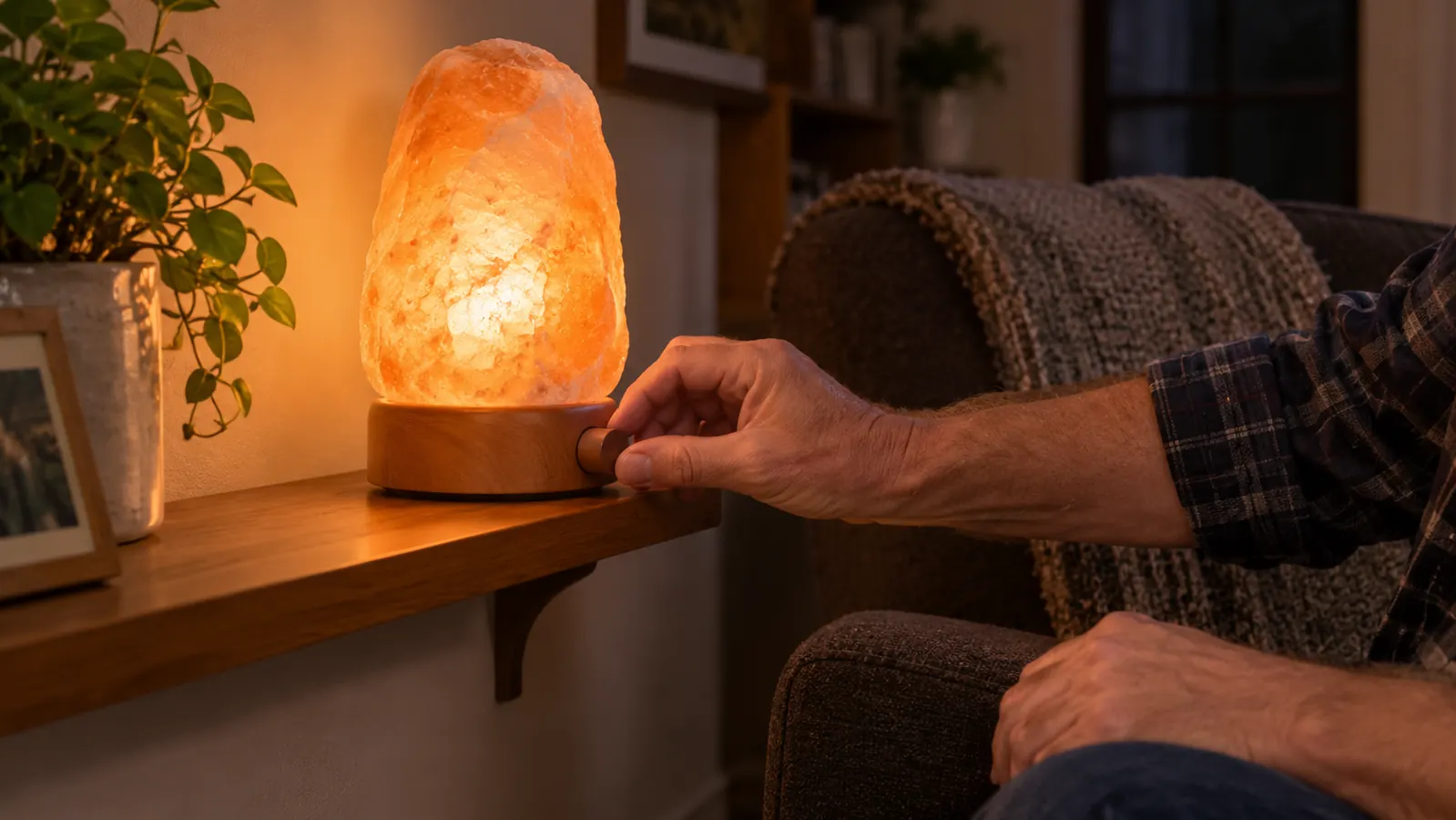
That single ceiling bulb was doing more damage than any amount of nicer upholstery could repair. Overhead light is task light. It is designed so you can find a dropped button on the floor. A reading nook is a stopping place, and stopping needs a light that sits below eye level, close to you, and dim enough that your shoulders come down. The first evening I switched off the ceiling fixture and switched on the salt lamp, I sat for forty minutes without checking my phone. I had not done that in years.
The Himalayan Glow lamp itself is simple in the way I like. It is a hand chipped piece of salt stone on a wooden base, about four and a half inches square and seven inches tall, weighing around five pounds, so it fits on a narrow shelf without crowding it. It runs off a USB cable, which I mention because it means you do not need to free up an outlet, only the small adapter from an old phone. There is one control. A touch dimmer switch. You touch it and the light steps down or up and that is the whole interaction. Five watts. I do not think about it again until I reach for it at night.
Now the honest part, because you will read other things elsewhere. It is a light. A hollowed stone with a five watt LED inside and a dimmer on it. It does not clean the air in my house and I have no instrument to measure whether it does anything at all beyond glow. What I can tell you is that it is the only light in this house I can sit beside for an hour without feeling keyed up, and that before it there was a bare bulb and an empty chair. That was reason enough for me.
Step 3: Get the seat and the floor right, in that order
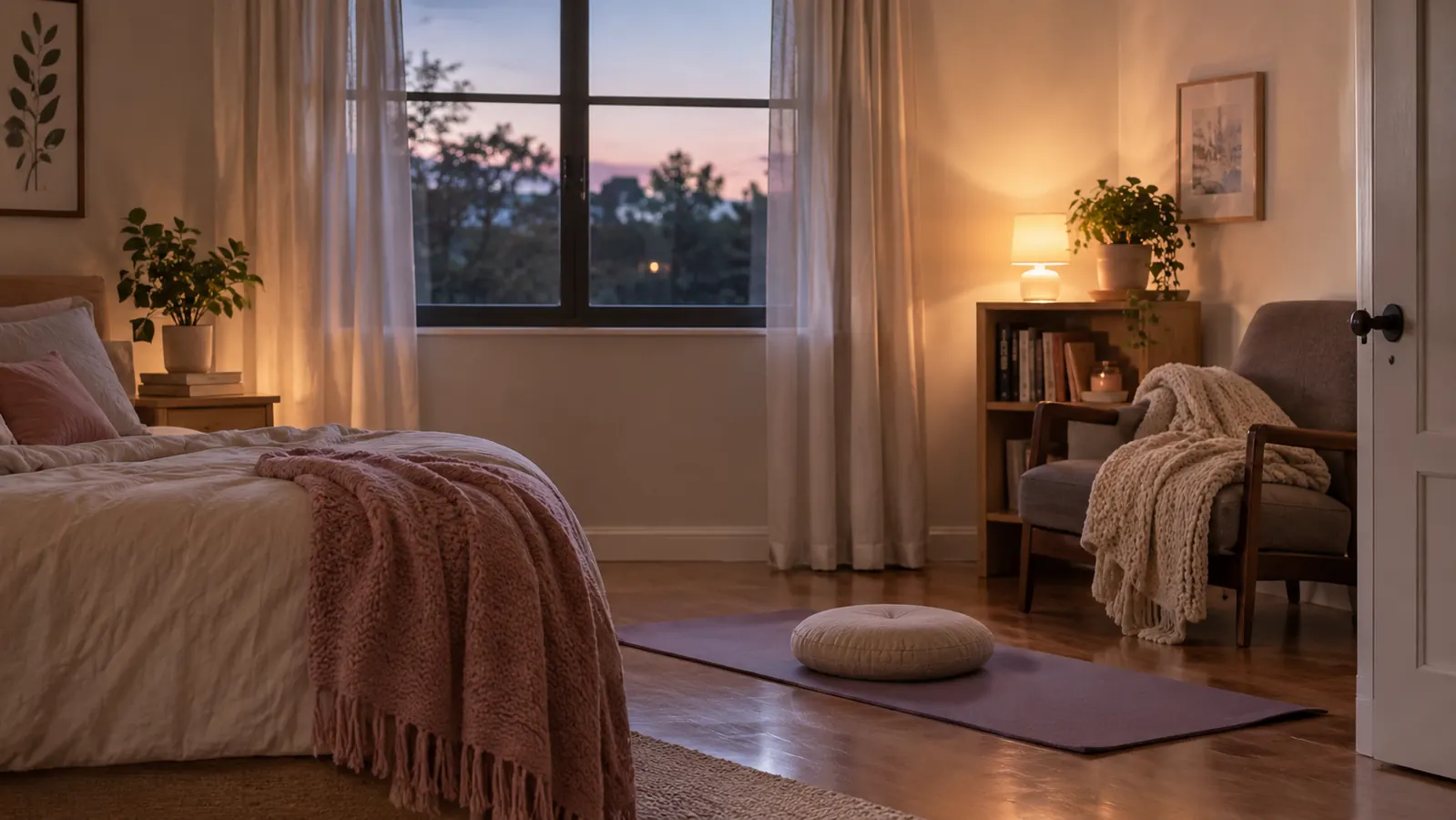
I sat on a folded bath towel for the first two weeks, which I do not recommend and which I am telling you only so you know I started exactly where you are. A proper floor cushion changed my mornings. I use a round zafu on top of a yoga mat that stays down permanently. Ten or fifteen minutes of sitting still with coffee, most days, before Dale is even back from his walk. The mat stays out because if I have to unroll it, I will not unroll it.
If you are not a floor person, skip this step entirely and put the money into the chair. The chair is the whole point for most people. Sit in it for fifteen minutes with a book before you buy a lamp for it, and notice your neck at the end of the fifteen minutes. A chair that is two inches too deep will send you to the chiropractor, and no amount of good light will save it.
Whatever you choose for the floor, keep it small enough that you stop noticing it. The mistake I see in photographs is a whole arrangement down there: a cushion, a basket, a folded blanket, a tray with a candle on it. All of that is more objects to move before you can sit. My floor has a mat and a cushion and nothing else, and I can be sitting down within thirty seconds of walking into the room.
Step 4: Add exactly one soft layer, within arm's reach
A reading nook wants something to put over your legs, and it needs to be reachable without standing up. Not folded in a basket across the room. Draped over the arm of the chair. The chunky knit throw I bought in February spends most of the day on the living room sofa and moves to the reading chair after dinner. I have machine washed it once, on cold and gentle, and laid it flat to dry on the guest bed, and it came through fine. Mostly it gets spot cleaned.
The throw matters for a reason that is not warmth, though it is that too. A corner with one fabric texture in it reads as finished. Before the throw, my chair looked like furniture waiting for something to happen to it. After it, the corner looked like a place a person uses. That is an odd thing to write down, but it is true, and it costs less than repainting a room.
One caution, and I mean this. Keep the throw on the opposite side of the chair from the lamp. Mine sits on a shelf with clearance above it, and I still do not drape anything near it. A lamp you reach for with your hand is a lamp you can knock with a sleeve, and the stone is not water resistant, so there is no wiping up after a spill. Dry cloth only, when you think of it.
Step 5: Keep the surfaces almost empty, and keep them that way
My shelf holds the Himalayan Glow lamp and one small dish for a hair tie and a pencil. That is the entire inventory. Every time I have let a second object settle up there, the corner started behaving like a table, and a table is a place where things get put down and then pile up. A reading nook stays a reading nook by staying slightly under furnished.
Books are the one exception, and even then only the book you are actually in the middle of. I keep one on the shelf and the rest on the bookcase in the hall. When I finish it, it goes back. This sounds fussy written out. It takes four seconds, and it is the difference between a corner that invites you and a corner with a job pending.
The last thing is the phone. Mine stays in the kitchen for the hour before bed. What I like about the lamp is that it offers me nothing to fiddle with. One touch dimmer, three or four useful levels, and no display staring back at me with the time and a notification count. I did not know I wanted that in a lamp until I had it, and now it is the reason I leave the phone where it is.
What Else Helps
Two small things beyond the five steps. The first is a sound source whose only job is to cover the house, and in my case that job belongs to a small sound machine on the dresser in the main bedroom, not in the quiet room. The noise I am covering is the furnace in the basement kicking on under the hallway, and Dale getting up at five thirty. Inside the quiet room I want to hear the house. That is rather the point of the room.
The second is a rule about light for actual reading. If you read paper books and you need real light on the page, the salt lamp will not be enough by itself and I would not pretend otherwise. I read in the chair with the lamp on for the feeling of the thing, and I read in bed with a proper lamp. Two different jobs. The nook lamp is there to make the hour before sleep feel like an hour before sleep.
And a word on the diffuser, since it sits twenty feet away in the other room. About an hour of cedarwood while I read is pleasant and I wipe the tank out every Sunday, but I would not put one in a small closed corner. The room starts to feel like a candle shop. The quiet room got a lamp and a chair and a throw, and that was already one thing more than it needed.
If you are the sort of person who likes a checklist, here is the whole of it in one sentence. Pick the corner you will use after dark, kill the overhead light, put one small dim lamp low and close, sit on something that does not hurt, and keep the shelf nearly bare. Everything else people write about nooks is decoration on top of those four things. I spent two years not sitting in a perfectly good chair because nobody told me the light was the problem.
The first evening I switched off the ceiling fixture and switched on the salt lamp, I sat for forty minutes without checking my phone. I had not done that in years.
One touch, one dimmer, and the corner finally gets used
Mine has been on the shelf beside the reading chair since the first week of February, on the lowest setting most nights. It is a light, not a gadget, and that turned out to be what I wanted.
Amazon Check Today's Price on Amazon →