
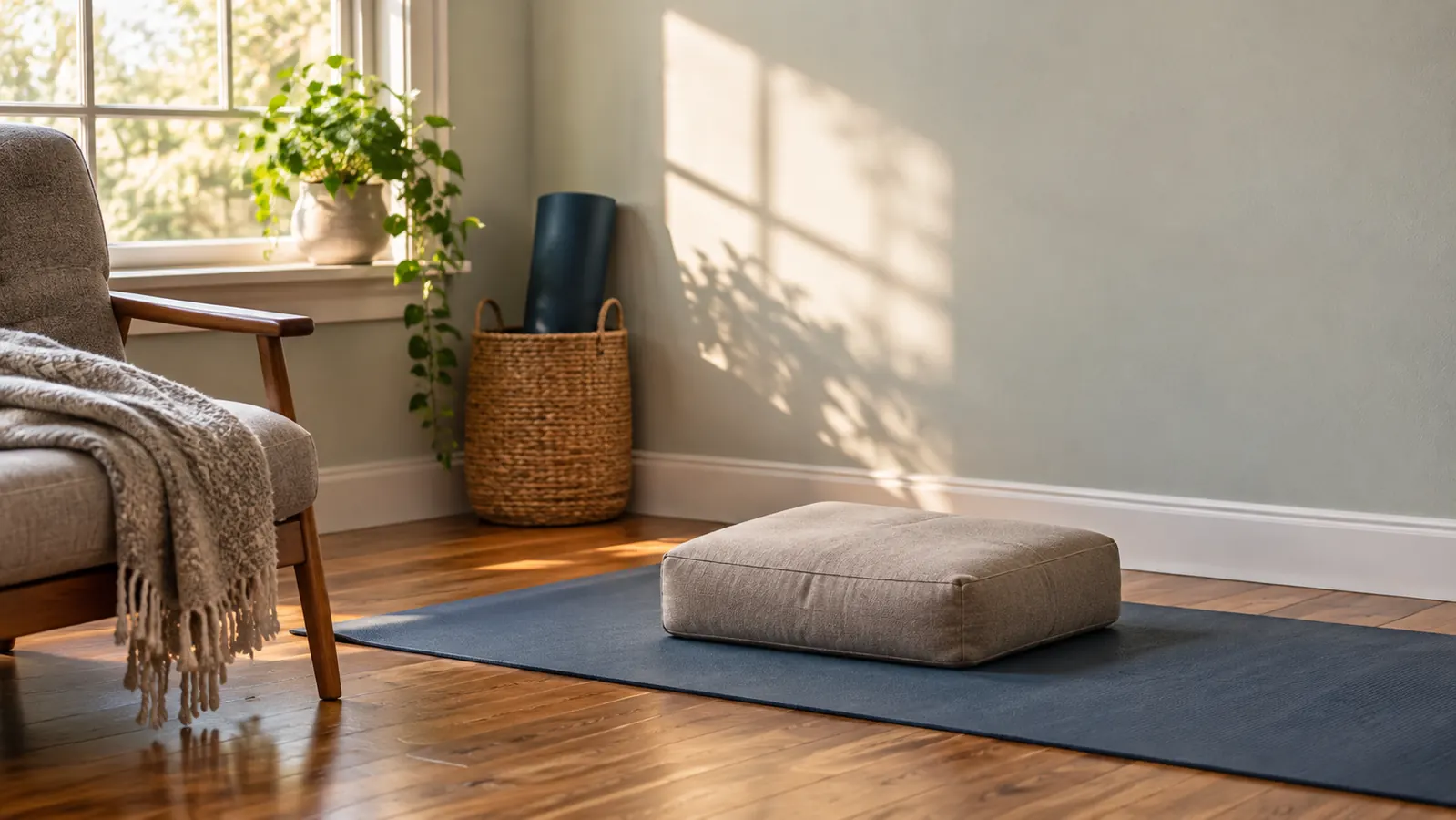
Every house has a corner that collects things. Mine was in the smallest bedroom, the one with the good morning light, and for the better part of a year it held a folding chair, two boxes of books I kept meaning to donate, and a rolled yoga mat that never got rolled out. In January I decided that corner would do one job. Not storage. Not a spare surface. A place to sit on the floor for ten or fifteen minutes most mornings and do nothing in particular.
I am not a decorator and I did not want a project. What I wanted was a spot I would actually use at 7:30 in the morning in February, when the house is cold and the day has not started. The Retrospec Sedona zafu is the piece that made the corner usable, but it was the fourth decision I made, not the first. Buy a cushion before you decide where it goes and it ends up in a closet with the mat. So here is the order that worked for me, and the parts I would do the same way again.
The One Piece in That Corner I Would Buy Again Without Thinking
The Retrospec Sedona is a firm floor cushion filled with buckwheat hulls, 17 inches long, 10.5 inches wide and 5.5 inches high, with a cotton cover that goes in the washing machine. You can unzip the inner compartment and take hulls out until the height suits you. Nine months in, it still holds its shape.
Amazon Check Today's Price on Amazon →The Five Steps, in the Order That Worked
Step 1: Choose the corner by the light, not by the furniture
The quiet room has two windows, and the corner I chose gets the morning sun from about seven until nine. That was the entire reason. I sat on the floor in three different corners over one week with a folded towel under me and paid attention to two things: whether the light was on my face instead of behind me, and whether I could hear the rest of the house.
The corner by the door lost. Every time Dale walked past on his way to the garage, I looked up. The corner across from the closet lost too, because I could see the closet. What I ended up with is the corner that has a wall on one side and a window on the other, about three feet of clear floor, and nothing in my line of sight except the wall and the maple in the front yard.
One thing I got wrong first: I tried the space behind the reading chair, which looked right in my head and felt like sitting in a hallway in practice. You want a wall at your back or beside you, and you want to be out of the path between the bedroom door and everything else. Sit on the floor in the candidate spot before you commit. It takes four minutes and it saves you moving a cushion three times.

Step 2: Clear the floor and give the cushion one permanent home
Empty the corner completely. Not tidy it, empty it. The boxes went to the garage, the folding chair went to the basement, and the mat got unrolled and stayed unrolled. That mat is the boundary of the whole thing, about six and a half feet by two along the wall, and nothing else is allowed on it. If something lands there, it gets moved that day and not that week.
The mat does two jobs. It marks the floor as a place with a purpose, and it keeps a cushion from sliding on bare wood. If you have carpet you can skip it, but I like the edge it gives me. It tells my feet where to go without my having to think about it.
The cushion itself lives on the mat and does not travel. That sounds fussy and it is the single biggest reason the corner gets used. When the mat was in the closet, sitting down required a decision every morning. Now the decision was made back in February and I just walk over and sit. Do this part before you shop, because it is the part that determines whether you will use what you buy.
Step 3: Get the height right, which is mostly about the fill
For about a year before this I sat on a folded bath towel, and I want to be honest about what that was like. It was fine for four minutes. A towel compresses, your hips drop to the level of your knees, and after a while your lower back starts doing work it should not be doing. The Retrospec Sedona is firm and it stays firm, because it is filled with buckwheat hulls rather than foam. It is 5.5 inches high. That half a foot is the whole difference between sitting on the floor and wanting to get up off it.
The other thing buckwheat gives you is adjustment. There is an inner compartment you can unzip, and you take hulls out or put them back until the height suits you. I took out two handfuls in the first week and put them in a jar in the closet, because I was not sure yet. My husband Dale is 61 and has longer legs than I do. He sat on it once at the fuller fill, said it was fine, and went back to his chair, which is about as much commentary on cushions as I have ever gotten out of him.
The dimensions matter more than you would expect. It is 17 inches long and 10.5 inches wide, so it is a rectangle rather than a round pouf, and that shape is what lets you sit cross-legged with your knees supported or kneel with it between your calves. I use it cross-legged in the morning. In the evening, if my back is tired from the garden, I turn it and kneel.
Care is simple enough that I actually do it. The cover is cotton and the listing says machine wash. I wash the cover on cold every couple of months and lay it flat to dry, and I have not had a problem yet. There is a one year limited warranty, which I have not needed. The whole cushion weighs about a pound, so moving it to vacuum underneath is not a chore.
Step 4: Put the light low and warm
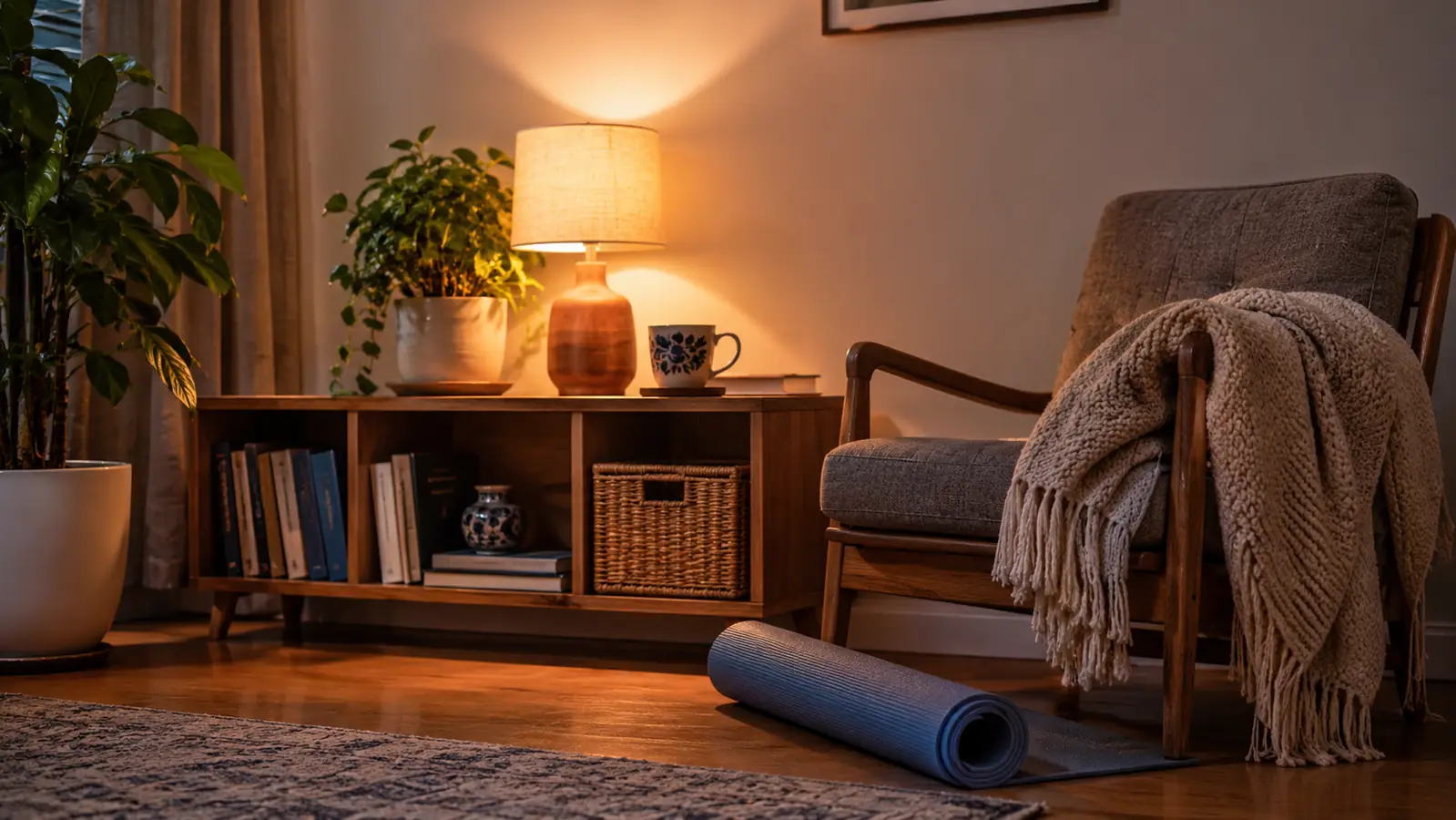
The overhead light in that room is a bare fixture with a sixty watt bulb, and it undoes everything. Sitting on the floor under it feels like being kept after school. What fixed the room was a small lamp on a low shelf beside the chair, below eye level when I am seated. Mine is a salt lamp with a touch dimmer and it stays on the lowest setting almost all the time.
I will say plainly what that lamp is: a light. It is not a gadget and it does nothing to the air in the room. What it does is glow at roughly the brightness of a candle, which is the right amount of light at 7:30 in the morning in February and at 9:30 at night in July. Warm and low beats bright and overhead in any room whose job is winding down.
One small thing I learned the hard way. Keep the lamp on a shelf, not on the floor. On the floor it gets knocked when you stand up, and the cord runs straight across the mat. On a low shelf it stays out of the way and it washes the wall instead of your eyes.
Step 5: Make it a routine before you make it pretty
For the first two weeks I treated the corner like furniture and did not sit in it once. What changed that was attaching it to something I already did. Coffee first. Then ten or fifteen minutes on the cushion. Then the day. I do not use an app, and I do not set a timer. I look at the clock on the stove as I come out of the kitchen, and most mornings it is twelve or fifteen minutes later when I look again.
I do not do anything elaborate. I sit, I breathe, I let my shoulders drop, and some mornings I stretch my arms overhead and roll my neck a few times. I am not going to tell you it fixed my sleep or my back. It did not, and that is not what it is for. It is fifteen minutes in a warm corner where nobody needs anything from me, and that is worth three feet of floor in a small bedroom.
Two rules keep it working. Nothing gets stored in the corner, and the cushion does not move. The day the mat becomes a place to set the laundry basket is the day the whole thing turns back into a corner that collects things. That has happened once. I moved the basket.
It is 5.5 inches of firm buckwheat hulls, and that half a foot is the whole difference between sitting on the floor and wanting to get up off it.
What Else Helps
A wall within reach. Mine is about eighteen inches from my right shoulder, and I put a hand on it when I stand up. If your corner has no wall, put the cushion near something solid, a dresser or the arm of a chair, so you have something to steady yourself. This matters more at 58 than it did at 38, and there is no reason to pretend otherwise.
A soft layer for the evening. The knit throw from the living room ends up over my legs most winter mornings. It is not part of the corner, it just visits, and I would not buy a second one for this room. Somewhere to put the hulls you take out also helps: a lidded jar in the closet is enough, and it means you can put them back in October when the fill has settled.
What I would skip: a second cushion, a bolster, a mat with a pattern I would tire of, and anything that has to be moved before you can sit down. The corner works because sitting down takes one motion. Every object you add is one more motion between you and the ten minutes. If you are wondering whether the corner or the cushion comes first, the answer is the corner, but only by a week. You will not keep a cushion in a corner you have not cleared, and you will not clear a corner you have no reason to sit in.
Clear the Corner, Then Put This on the Mat
The Retrospec Sedona is the piece that turned my cleared corner into a habit: buckwheat fill you can adjust through the inner compartment, a cotton cover that machine washes, 5.5 inches of firm height, and a one year limited warranty. If you have been sitting on a folded towel, you already know why this is the upgrade.
Amazon See the Retrospec Sedona on Amazon →